See the field clearly.
The Gita, ethical dilemmas and the psychology of fear become ways to ask what is happening inside us when a decision cannot wait.
How to Choose When Everything Is at Stake
When duty and love pull in different directions, when loyalty meets justice, when both sides hold something worth protecting—how do you choose?
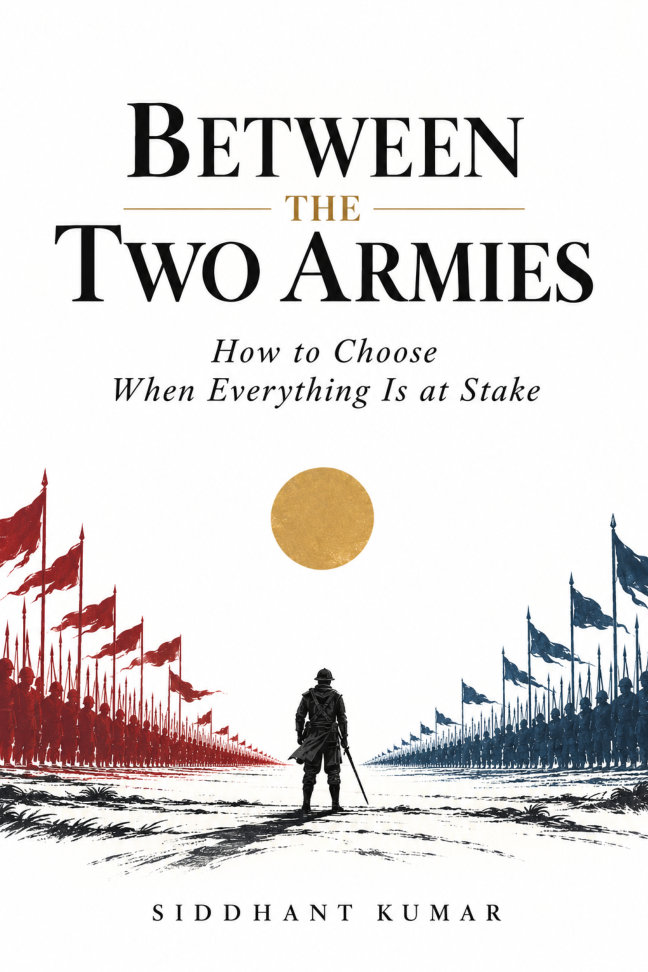
A warrior stands between two armies, his bow slipping from his hand. The battle is about to begin. He cannot move.
Between the Two Armies begins with Arjuna at Kurukshetra, then follows the problem of choosing through India’s epics, military history, other civilisations and the psychology of life under pressure.
These are not always contests between an obvious right and an obvious wrong. Duty can collide with love. Loyalty can collide with justice. A personal dream can collide with the needs of people who depend on you.
Across 26 chapters, Siddhant Kumar brings Krishna and the Indian epics into conversation with thinkers including Aristotle, Kant, Rawls, Marcus Aurelius, Epictetus, Frankl and Camus. He brings stories, arguments and questions to the moment when knowing what is right may still be harder than it sounds—and acting on it harder still. The aim is to help the reader examine a choice, take responsibility for it and live with what follows.
“When you stand between two armies, afraid, under pressure, and unsure what is right, how do you choose well, act well, and live with what you have chosen?”The question at the heart of the book
The manuscript returns to Krishna’s invitation to reflect fully and then choose. Its stories and arguments ask for examination, and its closing questions leave room for the reader to disagree.
The Gita, ethical dilemmas and the psychology of fear become ways to ask what is happening inside us when a decision cannot wait.
Chanakya, Machiavelli, Sun Tzu and histories of leadership raise questions about strategy, conscience and the right to be followed.
Friendship, discipline, ambition, failure and hope bring the argument back to everyday life and the person our repeated choices make.
The Gita is the starting point. Western ethics, Stoicism, Buddhist teaching, political strategy and modern psychology widen the argument. These thinkers are tested against stories and choices, rather than presented as interchangeable answers.
What will happen? What must never be done? What is my role here? The book sets these questions beside dharma, and uses Rawls’s veil of ignorance to ask whether we would accept a rule without knowing which side of it we would occupy.
Chapter 3 · The Trolley and the Dice
The Stoics’ distinction between events and our judgments meets the Buddhist story of an insult refused. These voices help examine anger, fear and the space between what happens to us and how we respond.
Chapters 2 and 6 · The Bow on the Chariot Floor / The Last Freedom
Frankl’s search for meaning, Nietzsche’s question of a reason to endure, and Adler’s ideas about contribution and relationships move the discussion beyond success toward responsibility. The manuscript also questions the limits of what attitude alone can change.
Chapters 6, 8, 23 and 25
Statecraft and strategy challenge an easy picture of goodness. Can a leader understand deception without becoming deceitful? What makes strength protective rather than predatory? Can the wiser victory be the battle avoided?
Chapters 10–12 · Statecraft, leadership and strategy
Sisyphus’s walk down the mountain becomes a way to think about work without a final victory. Kierkegaard’s reflections on life, understanding and looking backward join the question of how to live before everything makes sense.
Chapter 25 · The Long Road: Failure, Hope and “Whenever”
Plato’s cave and the Indian discussion of appearance and reality enter a chapter about the freedom to examine our own interpretations. The book brings traditions into conversation while acknowledging that their starting points differ.
Chapter 6 · The Last Freedom
Eight of the tensions the book works through. Open a question for a glimpse of its argument; the chapters supply the stories, objections and consequences behind it.
The manuscript places Kant’s refusal to lie beside Kaushika, whose truthfulness delivers innocent people to their killers, and Yudhishthira’s misleading words to Drona. Its answer asks readers to protect life without pretending that a clever half-truth makes deception innocent.
Chapter 3
Philippa Foot’s trolley problem opens a conflict between counting outcomes and treating a person as a tool. The book asks readers to test a choice through consequences, moral limits and the responsibilities of their role, rather than trusting arithmetic alone.
Chapter 3
Bhishma’s vow, Karna’s debts and Vibhishana’s break with Ravana expose the danger of confusing faithfulness with obedience. The book argues that loyalty to a country or a principle cannot require loyalty to someone’s wrongdoing.
Chapters 4 and 18
Arjuna’s crisis is a serious moral problem, not simply a failure of nerve. The closing chapter asks readers to distinguish fear to be mastered from conscience to be heard, and to test both against facts and honest counsel.
Chapters 2 and 26
The book refuses to let a useful result erase the means used to obtain it. Its histories of power and nation-building ask the reader to recognise achievement and harm together, without allowing one to cancel the other.
Parts Three and Four
Abhimanyu’s entry into the array is set beside the problem of obedience when one’s own side is wrong. Courage must be directed by a just purpose: protecting people can require holding ground, but it can also require refusing an order or ending a fight that serves only pride.
Chapters 17–19 and 26
Hanuman’s search for Sita, Sisyphus’s recurring labour and examples of warnings ignored lead to a difficult distinction. The book defends hope that sees the facts and acts, while questioning hope used as an excuse not to change course.
Chapter 25
Roger Boisjoly’s warning before Challenger and Hugh Thompson’s intervention at My Lai challenge the promise that doing right will always be rewarded. The manuscript asks us to judge decisions by what could be known when they were made, not only by how they turned out.
Chapters 18 and 25
Mythology, recorded history, thought experiments and an explicitly fictional case bring the questions into situations where someone must act.
Bhishma, Karna and Abhimanyu make courage complicated. The Mahabharata supplies lives in which admirable qualities can become vulnerabilities; the Ramayana brings Hanuman’s doubt and Vibhishana’s dissent. Greek stories, including Sisyphus, open another way of examining endurance.
Indian epics and Greek myth; the manuscript distinguishes original texts from later retellings.
From the Cherokee and the Trail of Tears to the American Civil War and My Lai, the book asks what a country owes its people, what a soldier owes a country, and when refusal becomes a form of service.
Parts Four and Five · History, power and the soldier’s choice
A junior engineer discovers conflicting test results just before a bridge opens. Her mentor has helped her family; her friend asks her to stay quiet. The final chapter works through her choice: verify the facts, distinguish fear from conscience, examine more than two options, act, and accept the cost.
Chapter 26 · Meera, Kabir and Mr Deshmukh are fictional characters.
The same questions return in smaller forms: joining a bully or speaking up, protecting a friend or telling the truth, chasing approval or keeping your attention. The book’s ethical arguments end in decisions a reader may face long before holding public power.
Chapters 7, 20–22 and 26 · Attention, friendship, discipline and repair
The chapters are designed to be read in order, with later ideas building on earlier ones. Most chapters end with questions for reflection and discussion.
Where is the real battle fought, how do we know what is right, and why is knowing it not enough to do it?
Fear, attention, status and desire: understanding the forces that shape a decision before we make it.
What is power for, and how does a leader earn the right to be followed?
What do a nation and its people owe each other, and can a good result ever excuse a terrible deed?
When must we fight, for whom, and at what cost?
The crowd, the friend and the silent witness: who stands beside us, and whom must we stand beside?
How do we keep going when we fall, and what should we build with the one life we have?
Selected passages from the supplied manuscript.
Both armies held something worth protecting. That is the kind of moment this book is mostly about: loyalty against justice, a friend against the truth, your family against strangers who also need you, your own dream against the people who depend on you.
Everything in these pages is an argument, a story or a question. You are free to accept it, reject it, or argue with it. Your mind is yours. Your life is yours. Your choices are yours.
Brief excerpts reproduced from the author’s manuscript. © 2026 Siddhant Kumar.
For the soldiers who went into the array knowing they did not know the way out.
And for every young person standing between two armies, wondering which way to walk.
Written for readers from about twelve years old to adults: students, teachers, parents and anyone thinking about courage, conscience, leadership or a difficult decision. Stories of war, prisons and loss are told plainly; younger readers may find it useful to discuss them with a parent or teacher.
Bring a pencil. Pause at the questions. Let the stories become a conversation about the choices in your own life.
An author, developer and researcher from New Delhi, India.
Siddhant’s writing returns to service, courage, responsibility and the lives behind the events we remember. His first book, Guardians in the Gale, is a collection of poetry honouring the Indian Armed Forces.
In this manuscript, he brings stories from epics and history into conversation with the pressures of ordinary life, asking how we can choose and act with greater care.
The Gita supplies the book’s central image and a recurring question. The book also draws on the Mahabharata, the Ramayana, military history, Greek and Roman stories, other traditions and modern psychology.
The book makes arguments and gathers its answers in the final chapter, but asks readers to test them against evidence and people they trust. Its purpose is thoughtful judgment and personal responsibility.
The author recommends reading the chapters in order because later ideas build on earlier ones. Individual chapters begin with stories and can also serve as starting points for discussion.
The manuscript names a readership from about twelve years old to adults. Some chapters discuss wars, massacres, imprisonment and death without graphic detail; conversation with a parent or teacher may help younger readers.
The supplied manuscript is marked “Draft manuscript · October 2026.” No purchase link or release date is listed here. Ask the author about availability at sid@siddhantkumar.in.
For book availability, readings, school visits or a thought you would like to share.
sid@siddhantkumar.in