Geopolitics · Maritime
Guardians of the Sea Lanes: India's Navy and the Red Sea Crisis
The sea is where the modern world's prosperity actually moves. The vast majority of global trade travels by ship, and a handful of narrow chokepoints — straits and canals where the sea lanes pinch together — carry a disproportionate share of it. When one of those arteries is threatened, the shock runs through the whole global economy: ships reroute, insurance premiums spike, delivery times stretch, and the price of everything from oil to consumer goods feels the strain.
In the mid-2020s, one of the world's most important maritime arteries — the corridor running through the Red Sea and the Gulf of Aden toward the Suez Canal — came under sustained attack, as missiles and drones turned a great trade route into a shooting gallery and a resurgence of piracy compounded the danger. The response of the Indian Navy — surging warships to sea to escort vessels, rescue crews and hunt pirates — revealed how far India has travelled from a coastal defence force to a genuine provider of security across the Indian Ocean. This is that story.
The artery under threat
To grasp why the crisis mattered, picture the geography. Ships carrying goods between Asia and Europe — an enormous share of world trade — funnel through the Red Sea to reach the Suez Canal, the shortcut that saves them the long and costly voyage around the whole of Africa. At the southern end of the Red Sea lies a narrow strait, and beyond it the Gulf of Aden and the Arabian Sea. Choke this corridor and you force a large fraction of global shipping onto a detour of thousands of extra miles, adding days, fuel and cost to every affected voyage.[1]
That is exactly what began to happen when attacks on commercial shipping in and around the Red Sea escalated, with vessels struck by missiles and drones and crews put in mortal danger. Shipping companies, facing an unacceptable risk to their ships and sailors, began diverting around the Cape of Good Hope, and the ripple effects reached economies far from the fighting. A crisis in one narrow sea became a problem for the whole trading world — and for India, which depends heavily on these sea lanes for its energy imports and its exports, the threat was direct and serious.
The world's prosperity floats. Threaten the sea lanes and you threaten everyone who eats, drives or buys.
Why India had to act
India's stake in the security of these waters is not abstract. A large share of its trade and a critical portion of its energy supplies pass through the western Indian Ocean and the Gulf. Millions of Indian citizens live and work in the Gulf region, and Indian sailors crew a significant portion of the world's merchant fleet — meaning that attacks on commercial shipping put Indian lives directly at risk, whatever flag the vessel flew. A threat to these sea lanes was, quite literally, a threat to India's economy and its people.[2]
There was a larger strategic logic too. India has long articulated an ambition to be the preeminent security provider in the Indian Ocean region, the resident power whose navy underwrites stability in its own maritime neighbourhood. A crisis on this scale, in these waters, was precisely the kind of moment that ambition exists for. To stand aside while a great trade artery in its own region came under attack would have belied every claim India makes to maritime leadership. To act — decisively, capably, at scale — would prove those claims true.
The Navy surges to sea
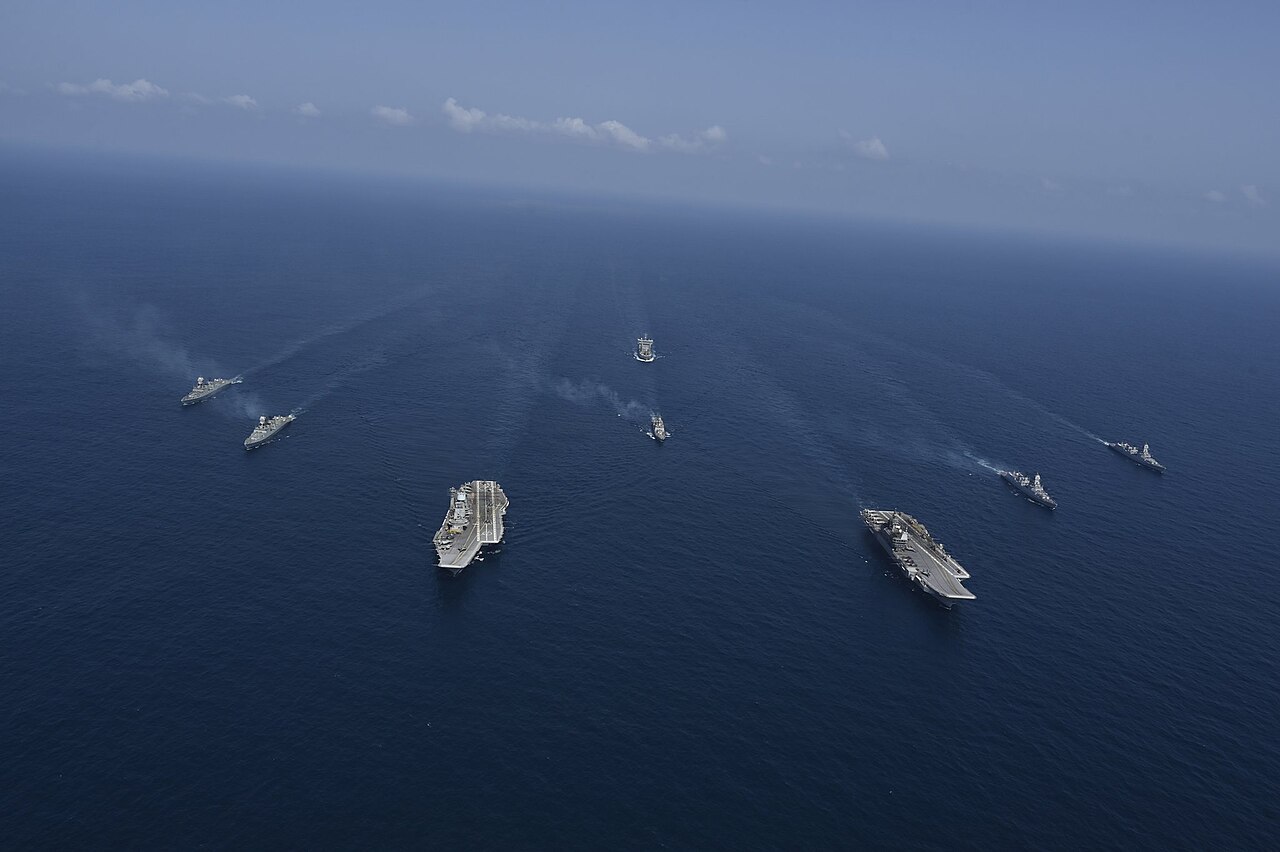
And act it did. The Indian Navy mounted a large and sustained deployment into the Arabian Sea, the Gulf of Aden and the wider region — one of its most significant peacetime operational surges. It put warships on station along the threatened sea lanes, positioned to deter attacks, escort vulnerable vessels, and respond to distress calls. The scale was substantial: multiple frontline warships, backed by maritime patrol aircraft and drones providing surveillance across vast stretches of ocean, sustained on station far from home for extended periods.[3]
The Navy's mission had several strands. It provided reassurance and, where needed, escort to merchant shipping, giving crews the confidence that help was at hand. It responded to vessels that came under attack — reaching stricken ships, fighting fires, and rescuing and caring for crews. And it took on a resurgent piracy problem in the same waters, intercepting hijacked vessels and freeing captured sailors. Across these operations the Indian Navy demonstrated not just presence but the ability to act — to reach a ship in distress hundreds of miles away and do something useful when it arrived.
Rescues that made the case
The abstract argument for maritime power is made concrete by specific rescues, and the crisis produced several that captured the point. Indian warships responded to merchant vessels struck by attacks, reaching them to extinguish fires and evacuate or treat injured crew. In the anti-piracy line of effort, the Navy intercepted hijacked ships and, in dramatic operations, compelled the surrender of pirates and freed captured crews — including sailors of many nationalities, not only Indians.[4]
These operations mattered beyond their immediate humanitarian value, because they were witnessed by the world. When an Indian warship freed a hijacked vessel and rescued its multinational crew, or reached a burning ship to save its sailors, it sent a message that no policy paper could: that India's navy could operate far from home, respond quickly to crises across a huge maritime expanse, and deliver tangible security to the global commons. It was maritime power translated into rescued lives and secured cargoes — the most persuasive advertisement a navy can offer.
The cost-exchange problem at sea
The crisis also exposed one of the hardest problems in modern naval warfare, one directly relevant to India's future. Many of the attacks on shipping used cheap drones and missiles — weapons that cost relatively little to build and launch. Defending against them, however, often meant firing sophisticated and expensive interceptor missiles from warships. This creates a punishing cost-exchange imbalance: the defender spends far more to stop each attack than the attacker spends to launch it, and no navy, however wealthy, can sustain such an exchange indefinitely.[5]
The lesson is one India's naval planners have absorbed. The future of maritime defence against cheap, mass threats cannot rest solely on expensive one-for-one interceptors; it must include cheaper means — electronic warfare to jam and spoof incoming drones, directed-energy weapons that engage targets for the cost of electricity, and layered defences that reserve the expensive missiles for the threats that truly require them. The Red Sea crisis was, among other things, a live demonstration of why India's parallel investments in counter-drone technology and directed-energy weapons matter for its navy as much as for its borders.
The bigger picture: the Indian Ocean
The crisis fits into a longer story about the Indian Ocean and India's role in it. This ocean, which bears India's name, is one of the most strategically vital bodies of water on earth — the highway for much of the world's energy and trade — and it is increasingly contested, with outside powers building presence and influence across its rim. India has responded by expanding its naval reach, deepening security partnerships with island and littoral states, positioning itself as a "net security provider" for the region, and cultivating the surveillance and cooperation networks that let it keep watch over its maritime neighbourhood.[2]
The Red Sea deployment demonstrated the maturity of this posture. India acted largely on its own initiative and under its own command to protect shipping and lives, coordinating with others where useful but not dependent on anyone's permission. It showed a navy capable of sustained, distant operations — a blue-water force, not a coastal one. And it reinforced India's standing among the states of the region and the wider maritime world as a power that will step up when the sea lanes are threatened, an actor whose presence adds to stability rather than to rivalry.
A navy proves itself not in the review parade but in the rescue — when a burning ship, far from home, sees your flag on the horizon.
From brown water to blue: the Navy's transformation
To appreciate the significance of India's Red Sea deployment, one must understand how far the Indian Navy has travelled to be capable of it. For much of its history the navy was, of necessity, a modest coastal force — a "brown-water" navy concerned mainly with defending India's immediate shores, with limited ability to operate far from home for long periods. The transformation into a "blue-water" navy capable of sustained operations across distant oceans has been one of the quiet epics of India's military development, requiring not just more ships but a whole architecture of reach: aircraft carriers, large surface combatants, replenishment vessels to sustain forces at sea, maritime patrol aircraft to extend surveillance across vast distances, and the doctrine and training to tie it all together.[2]
A blue-water navy is defined precisely by the ability to do what India did in the Red Sea crisis — to deploy substantial forces far from home, sustain them on station for extended periods, and conduct meaningful operations at a great distance. This is enormously demanding. Warships far from home need fuel, food, spares and maintenance; keeping them effective thousands of miles away requires replenishment at sea and a logistical tail that few navies possess. Surveillance across huge maritime expanses requires patrol aircraft and drones and the networks to fuse what they see. The very fact that India could surge a large force to the Arabian Sea and Gulf of Aden and keep it there, doing useful work, was itself the proof of a transformation decades in the making.
Behind the deployment, too, lies a long and deliberate effort to build the fleet at home. India has invested heavily in indigenous warship construction, building destroyers, frigates, corvettes and even an aircraft carrier in its own shipyards — an achievement that places it among a small group of nations able to construct such vessels domestically. The ships that sailed to protect the sea lanes were, increasingly, Indian-built, and the crisis was thus a demonstration not only of naval reach but of the industrial depth that underpins it. A navy that can build its own ships and sustain them far from home is a navy that has genuinely arrived.
The scourge of piracy returns
One strand of the crisis deserves particular attention because it revived a threat many had thought largely defeated: piracy. In the waters off the Horn of Africa and across the western Indian Ocean, piracy had surged years earlier before being beaten back by sustained international naval effort. The turmoil surrounding the Red Sea crisis created conditions for its resurgence, and hijackings of merchant vessels returned to waters that had grown relatively safe — an old menace exploiting new chaos.[4]
The Indian Navy took on this threat directly and with notable success, conducting operations to intercept hijacked vessels and free their captured crews. In several dramatic actions, Indian warships and their marine commandos compelled the surrender of pirates and rescued the sailors they had seized — crews of many nationalities, not only Indians, a fact that underscored India's role as a provider of security for the whole maritime community rather than merely a guardian of its own citizens. These anti-piracy operations were among the most visible and materially successful parts of India's response, producing exactly the kind of tangible result — hijacked ships freed, captive sailors rescued — that demonstrates naval power in its most humanitarian and least ambiguous form.
The return of piracy carried a broader lesson about the fragility of maritime order. The safety of the sea lanes is not a natural condition but a maintained one, sustained by the continuous presence and effort of capable navies; remove or distract that presence, and old threats return quickly. India's willingness and ability to step into the anti-piracy role, sustaining the order that keeps the sea lanes safe, was a demonstration of exactly the kind of persistent security provision that its ambition to be the preeminent power in the Indian Ocean requires. Order at sea must be worked for, and India showed it was willing to do the work.
The Indian Ocean as the arena
The Red Sea crisis, though it unfolded in a specific corner of the sea, belongs to a much larger story about the Indian Ocean and the contest for influence within it. This ocean, which bears India's name, is among the most strategically vital bodies of water on the planet — the great highway for much of the world's energy and trade, the route along which oil flows from the Gulf to the economies of Asia, and the maritime space that connects Africa, the Middle East, South Asia and the Far East. Whoever shapes the security of these waters shapes the flow of the world's commerce.[2]
India has long harboured the ambition to be the preeminent security provider in this ocean — the resident power whose navy underwrites regional stability, whose presence reassures the smaller states of the region, and whose influence shapes the maritime order. That ambition is increasingly contested, as outside powers extend their naval reach into the Indian Ocean, building ports, basing forces, and cultivating influence along its rim. The competition for the Indian Ocean is one of the defining strategic contests of the era, and India's ability to act decisively in crises like the one in the Red Sea is central to making good on its claim to maritime leadership.
India has pursued that leadership through many instruments beyond crisis response: deepening security partnerships with the island states and littoral nations of the region, providing them with equipment, training and assistance; building the surveillance networks and information-sharing arrangements that let it keep watch over the vast maritime expanse; and positioning itself as the natural first responder to the region's maritime emergencies, from humanitarian disasters to security crises. The Red Sea deployment was, in this light, not an isolated event but a demonstration of the whole posture — the resident power stepping up when the sea lanes in its own ocean came under threat, precisely as a preeminent maritime security provider should.
The energy lifeline and the human stake
Beneath the strategic abstractions, India's stake in the security of these waters is intensely concrete, and it comes down to two things above all: energy and people. India is a vast and growing economy that depends heavily on imported energy, and a critical portion of that energy — the oil and gas that power its industries, its transport and its homes — flows by sea through the western Indian Ocean and the Gulf, along the very routes the crisis threatened. A serious and sustained disruption to these sea lanes is not a distant inconvenience but a direct threat to the energy lifeline on which India's economy runs.[2]
The human stake is equally direct and, in its way, more visceral. Millions of Indian citizens live and work in the Gulf region, their remittances a significant contribution to India's economy and their safety a responsibility the Indian state cannot ignore. And Indian sailors crew a substantial share of the world's merchant fleet — meaning that when commercial vessels came under attack in the Red Sea, Indian lives were directly at risk aboard ships of many flags. The threat to shipping was, in a very real sense, a threat to Indian citizens, and the protection of those citizens is among the most fundamental obligations of any government.
This combination — the energy lifeline and the safety of citizens and sailors — made the crisis unavoidably India's concern, whatever the flags the threatened vessels flew. It transformed a distant maritime security problem into a matter of direct national interest, and it gave India both the motive and the moral standing to act. When the Indian Navy surged to protect the sea lanes and rescue crews, it was defending not an abstraction but the concrete interests of the Indian economy and the concrete lives of Indian people — a defence of national interest in its most tangible form.
Acting alone, cooperating with all
One of the most revealing features of India's response was its posture toward the other naval powers operating in the same waters, for it illuminated the distinctive way India exercises power. The Red Sea crisis drew warships from many nations, and various multinational coalitions and arrangements formed to protect shipping. India, characteristically, chose to act substantially on its own initiative and under its own national command — deploying its forces, protecting shipping and conducting operations independently, while coordinating and sharing information with others where useful, but without subordinating itself to any coalition or seeking anyone's permission.[3]
This posture reflects India's deep-seated commitment to strategic autonomy — its preference to retain full control over how and when its forces are used, rather than binding itself to alliances or coalitions that might constrain its freedom of action. It is a distinctively Indian approach to the exercise of naval power: cooperative where cooperation serves India's interests, but independent in command and decision, guarding the autonomy that India prizes above the convenience of coalition. In the Red Sea, India demonstrated that it could contribute meaningfully to maritime security on its own terms, adding to stability without surrendering its independence.
The approach carried a broader signal about India's conception of its role. It positioned India as a capable and responsible security provider that could act decisively in its own right, neither a follower in someone else's coalition nor a free rider on others' efforts, but an independent power pulling its own weight in securing the global commons. For a nation aspiring to leadership in the Indian Ocean and beyond, this demonstration of independent capability — the ability to act alone when its interests demanded, while cooperating where useful — was precisely the posture its ambitions required, and the crisis showed it could sustain that posture in practice.
The economic shockwaves
The crisis was a vivid demonstration of how a threat to a single maritime chokepoint can send shockwaves through the entire global economy, and understanding those ripples explains why maritime security is an economic imperative and not merely a military one. When shipping companies began diverting their vessels away from the Red Sea and around the Cape of Good Hope to avoid the danger, the consequences cascaded outward: voyages that had taken a certain number of days now took many more; fuel costs rose; shipping capacity was effectively reduced as vessels spent longer at sea; and insurance premiums for ships transiting the danger zone spiked dramatically.[1]
These disruptions translated into real economic pain far from the fighting. Delivery times stretched, supply chains were strained, and the added costs worked their way into the price of goods. For an economy like India's — deeply integrated into global trade, dependent on imported energy, and reliant on the smooth functioning of the sea lanes for both its imports and its exports — the disruption was a direct economic threat. The crisis underscored a fundamental truth of the modern world: that prosperity depends on the free and secure movement of goods by sea, and that a threat to the maritime arteries is a threat to the economic wellbeing of every nation that trades.
This economic dimension gives maritime security a significance that extends far beyond the military. The security of the sea lanes is, in a real sense, the security of the global economy, and the navies that protect those sea lanes are guardians not only of ships and sailors but of the trade and prosperity that flow through them. India's willingness to deploy its navy to protect the sea lanes was thus an act of economic self-interest as much as of security — a defence of the trade and energy flows on which its economy depends — and a demonstration that it understands the deep connection between maritime security and national prosperity. In an age when so much of the world's wealth moves by sea, the ability to keep the sea lanes open is among the most valuable things a navy can provide, and the crisis showed why India regards that ability as essential to its economic future.
The expeditionary precedent
The Red Sea deployment set a precedent that may prove as significant as the operation itself, because it demonstrated an expeditionary capability — the ability to project military power far from home shores, sustain it there, and use it to protect national interests at a distance. For much of its history, India's military posture was essentially defensive and continental, focused on guarding its land borders and its immediate maritime approaches. The capacity and willingness to deploy substantial naval forces thousands of miles away, for months, to secure interests in distant waters, marks a genuine evolution in how India conceives and exercises its power.[2]
Expeditionary capability is the hallmark of a major power with global or at least regional interests, and it reflects a recognition that India's interests now extend far beyond its immediate neighbourhood — to the sea lanes that carry its energy and trade, to the regions where its citizens live and work, to the distant waters whose security affects its prosperity. A nation whose economy depends on global commerce and whose citizens are spread across the world cannot confine its security concerns to its own borders; it must be able to act where its interests are threatened, however far away. The Red Sea deployment showed that India increasingly possesses both the capability and the will to do so.
This evolution raises questions India will continue to grapple with as its power and interests grow. How far should its expeditionary reach extend? What interests justify the projection of force at a distance? How should it balance the demands of distant operations against the enduring priority of its land borders and immediate maritime approaches? These are the questions of a rising power learning to match its growing capabilities to its expanding interests, and the Red Sea crisis was, in a sense, a live exercise in answering them. The precedent it set — of India acting decisively and independently to protect its interests in distant waters — is likely to be one that future crises build upon, as India grows into a power whose security horizon extends well beyond its own shores.
What the crisis revealed
Strip away the specifics and the Red Sea crisis revealed something enduring about where India now stands. A generation ago, a crisis of this kind in these waters would have been someone else's to manage; India would have watched, worried about its trade and its citizens, and hoped that others kept the sea lanes open. The transformation is that India no longer waits to be protected. It has built a navy that can project power and provide security across its own ocean and beyond, and it has the strategic confidence to use it when its interests and its people are at stake.
This is what the maturation of a great power looks like in practice — not in declarations, but in warships on station thousands of miles from home, in pirates surrendering to Indian marines, in the crews of foreign ships owing their lives to the Indian Navy. The sea lanes are the arteries of the modern world, and their security cannot be taken for granted in an age of cheap weapons and ambitious spoilers. The Red Sea crisis showed that India intends to be one of the guardians of those arteries — and that, when the moment came, it had both the will and the means to be exactly that.
Sources & further reading
- "Red Sea crisis," Wikipedia.
- "Indian Navy," Wikipedia.
- Ministry of Defence, Government of India — mod.gov.in.
- Press Information Bureau (PIB), Government of India — pib.gov.in.
- "Anti-ship missile," Wikipedia.
- Ministry of External Affairs, Government of India — mea.gov.in.