Defence · Industry
From Buyer to Seller: India's Defence Export Ambition
For most of its independent history, India held an unwanted distinction: it was, year after year, among the largest importers of arms on earth. A nation with a vast military, serious enemies and genuine engineering talent nonetheless bought most of its major weapons abroad — jets from Russia and France, submarines from Germany and France, artillery and rifles and radars from a shifting cast of foreign suppliers. Dependency was the defining feature of Indian defence, and every crisis exposed its cost.
That story is now being rewritten. Indian-made cruise missiles are being sold to foreign navies. Indian artillery, helicopters, patrol vessels, radars and armoured vehicles are finding buyers abroad. Defence exports, once a rounding error, have grown into a headline number the government cites with pride. The transformation is incomplete and its foundations are still thin in places — but the direction has genuinely changed. This is the story of how India began the long climb from arms buyer to arms seller.
The weight of dependency
To understand the ambition, you have to understand the trap it is trying to escape. Importing your weapons is not merely expensive; it is strategically corrosive. The supplier controls the spare parts, the upgrades, the software and, ultimately, the switch. In a war, a foreign government can slow or stop the flow of ammunition and components on which your fielded force depends. In peacetime, you pay a premium, wait years for deliveries, and surrender the industrial learning that comes from building things yourself.[1]
India lived this reality repeatedly. Sanctions after its 1998 nuclear tests bit into supply chains. Delays and cost overruns on imported platforms became routine. And the deeper cost was cumulative: every jet bought abroad was a jet India did not learn to build, every submarine imported was design knowledge not accumulated at home. A country that imports its arsenal remains, in a quiet but real sense, a strategic apprentice to those who make its weapons.
To import your weapons is to rent your sovereignty by the year, at a price the landlord sets.
The turn toward self-reliance
The policy response crystallised under the banner of self-reliance — atmanirbharta — and the broader Make in India drive. The logic was that India should not merely assemble foreign designs but design, develop and manufacture at home, and that the surest way to force that shift was to change the incentives: restrict imports of items India could make, reserve a growing share of the defence budget for domestic procurement, and open the sector to private industry alongside the traditional state-owned giants.[2]
Concrete instruments followed. The government published lists of items banned from import — "positive indigenisation lists" — signalling to industry that a guaranteed domestic market awaited whoever could build them. It raised the permitted level of foreign investment in defence manufacturing to draw in technology and capital. It carved out a share of the procurement budget specifically for domestic sources. And it pushed the sprawling network of state defence firms and research laboratories to partner with a rising private sector rather than monopolise it.
The point of all this was not autarky for its own sake. It was to build an industrial base deep enough that India could equip itself — and, crucially, that a base built for self-supply could then supply others. Exports were always part of the vision, because a defence industry that only ever sells to its own government is small, expensive and slow. To achieve scale and competitiveness, Indian arms makers needed foreign customers.
BrahMos: the flagship
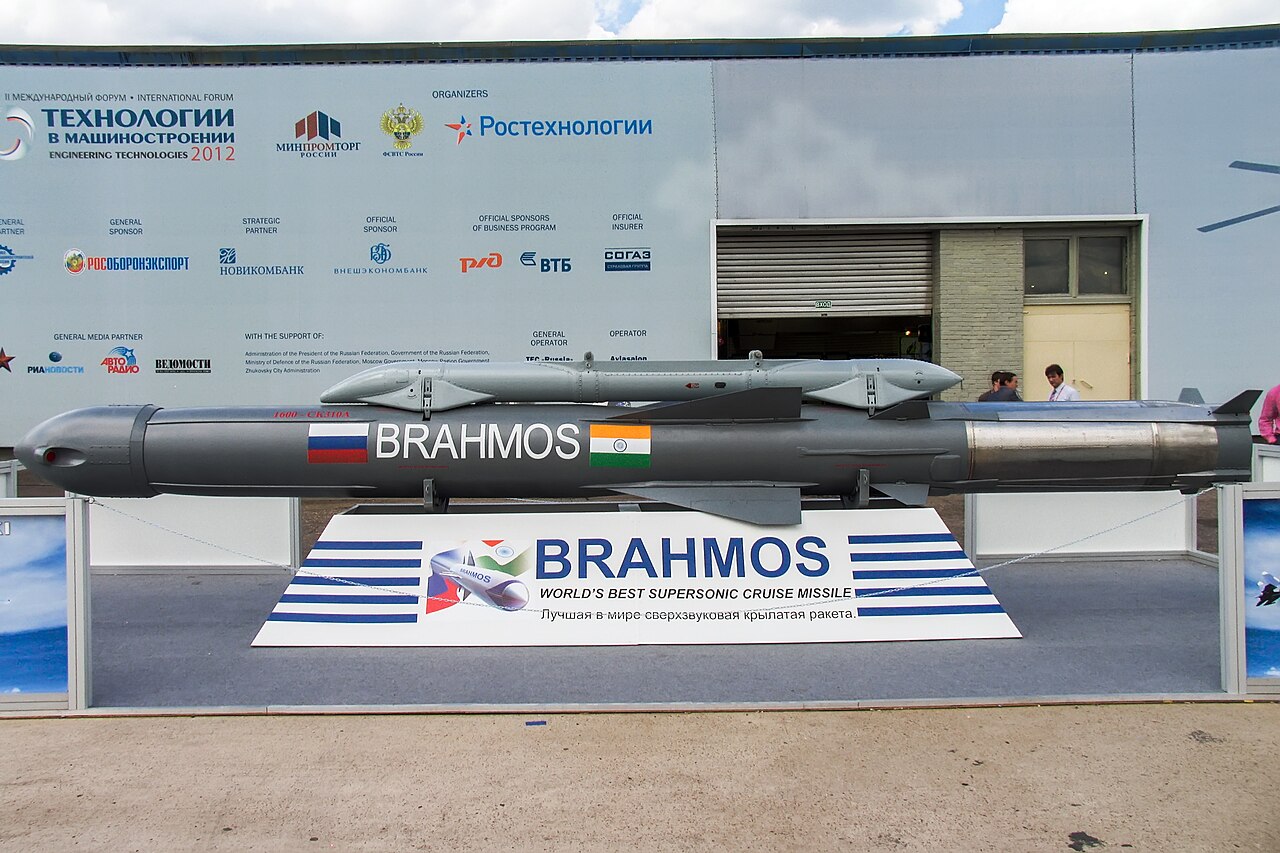
If India's export ambition has a symbol, it is the BrahMos cruise missile. Developed jointly with Russia, BrahMos is a supersonic cruise missile — one of the fastest in operational service — that can be launched from land, sea, air and submarine platforms. For years it was a prized part of India's own arsenal. Then it became something more: India's first big-ticket weapons export, when the Philippines signed to buy shore-based BrahMos batteries, a landmark deal that turned the missile into proof that India could sell serious military hardware to a foreign state.[3]
The significance of the BrahMos export runs deeper than the value of the contract. It demonstrated that Indian systems could meet the demands of a foreign military, pass the scrutiny of a foreign procurement process, and be trusted for national defence by another country. It opened conversations with other interested states across Southeast Asia and beyond. And it reframed India's identity in the regional imagination — no longer only a buyer circling the global arms bazaar, but a supplier with a flagship product other nations wanted.
Beyond the flagship: the widening catalogue
BrahMos is the headline, but the export catalogue is broadening beneath it. India's aerospace industry has pursued foreign sales of helicopters and light aircraft. Its shipyards, which have grown genuinely capable, have built and exported patrol vessels and offshore craft to friendly navies. Its ordnance and land-systems makers export artillery, ammunition, small arms and armoured vehicles. Its electronics firms sell radars, sensors and components. And a rising tier of private firms and start-ups exports drones, subsystems and specialised equipment that feed into other nations' defence supply chains.[4]
This breadth matters more than any single sale, because a durable arms-exporting nation is not one with a single hit product but one with a deep bench — a range of platforms, subsystems and services across domains, and the industrial capacity to sustain them for customers over decades. India's exports still lean on a handful of stars, but the widening base is the more important signal. Exports have grown many times over across the past decade, from a negligible figure to a substantial one, and the trajectory — not the absolute number — is what has changed the conversation.
Where India's offer is most competitive is at the intersection of capability and cost. Many of the world's arms buyers are not superpowers but middle and smaller states that need effective equipment they can actually afford, delivered without the political strings that great-power suppliers attach. India, with lower labour costs, a large industrial base, and a foreign policy of non-alignment that reassures buyers wary of dependency on any one bloc, is well placed to serve exactly that market — the vast middle of the global demand curve that the top-tier Western and Russian suppliers price out or politicise.
The obstacles that remain
Honesty requires acknowledging how far there is to go. India remains, even now, a large net importer of arms; the export figures, impressive in their growth, are still modest beside those of the established top-tier exporters. Some of the most sophisticated systems India fields — advanced fighter engines, certain sensors and munitions — still rely on foreign technology, which limits what can be freely exported and exposes the gaps in the domestic base. Building a jet engine of one's own, for instance, has proven one of the hardest technological climbs of all, and India is not yet at the summit.[5]
There are structural hurdles too. Defence exports require a mature system of end-use monitoring, export controls and government-to-government facilitation, since arms sales are as much diplomacy as commerce. They require Indian firms to offer the long-tail support — spares, training, upgrades over a platform's decades-long life — that buyers demand and that a young export industry finds hard to guarantee. And they require patience, because reputations in the arms trade are built over decades of reliable delivery, not won in a single flashy contract.
The state-owned giants that still dominate much of Indian defence production carry their own burdens of pace and efficiency, and the private sector and start-ups that could inject speed and innovation are still climbing toward the scale and access they need. The reform of India's defence-industrial base — making it faster, more competitive, more genuinely capable of independent design — is a work in progress, and the export ambition will rise or fall with it.
Why it is strategic, not just commercial
It would be a mistake to see the export drive as merely a matter of trade balances. Defence exports are an instrument of statecraft. When India sells BrahMos to a Southeast Asian nation facing pressure in its own waters, it is not only earning revenue; it is shaping the regional balance, deepening a strategic relationship, and positioning itself as a security partner in a contested neighbourhood. Arms sales create decades-long bonds of dependency and cooperation — the same bonds that once tied India to its own suppliers, now working in India's favour.[6]
There is also the matter of industrial depth as a war-fighting asset. A country that can build and export weapons at scale is a country that can sustain itself in a long conflict, replace losses, and adapt its equipment under the pressure of war. The export market disciplines and enlarges that capacity — it forces Indian firms to compete, to meet exacting standards, and to build at volumes larger than the home military alone would require. In that sense, every export order strengthens the industrial base on which India's own defence ultimately rests.
An arms industry that sells only to itself stays small. The export market is not a bonus — it is the forge.
The jet engine: India's hardest climb
No account of India's defence-industrial ambition is complete without confronting its single most stubborn failure and most revealing challenge: the jet engine. Building a modern fighter aircraft engine is among the very hardest feats in all of engineering — a small number of components must survive temperatures that would melt the metals they are made from, spinning at enormous speeds under crushing stress, for thousands of hours, with an absolute reliability on which pilots' lives depend. Only a handful of nations on earth have ever truly mastered it, and the knowledge is guarded as among the most sensitive any country possesses.[5]
India tried, and for decades it struggled. Its long-running effort to develop an indigenous fighter engine — the Kaveri programme — became a byword for the difficulty of the task, failing after years of effort to produce an engine that could power a frontline fighter, forcing India to rely on imported engines for its own indigenous aircraft. The failure was instructive rather than shameful: it demonstrated just how deep the well of metallurgical, thermal and manufacturing knowledge must be to build a modern engine, and how a nation cannot simply will such capability into being. The engine became the symbol of everything India had not yet mastered — the gap between assembling foreign designs and truly creating at the frontier.
This is why the prospect of jointly producing an advanced fighter engine in India, with a substantial transfer of technology from a leading foreign manufacturer, carries such weight for the export ambition. An arms industry that cannot build the engine at the heart of a fighter jet is an industry with a hole at its centre — dependent on foreign suppliers for the one component that no fighter can fly without, and limited in what it can export by that dependency. Closing that gap, finally mastering the engine, would remove one of the last great limits on India's ability to build and export complete, genuinely indigenous combat aircraft. It is the hardest climb, and reaching its summit would matter more to India's export future than almost anything else.
The state giants and the private challengers
The structure of India's defence industry is central to understanding both its progress and its limits, because it is a system in the midst of a profound and contested transition. For most of independent India's history, defence production was the near-monopoly of the state — a network of government-owned ordnance factories, shipyards and public-sector undertakings that built what the military needed, insulated from competition and, critics long argued, from the discipline of efficiency and pace that competition brings.[2]
These state giants built genuine capabilities — India's warship-building industry, in particular, grew into something world-class, capable of constructing sophisticated vessels including an aircraft carrier at home. But the state-dominated model also carried the burdens of any monopoly: slow timelines, cost overruns, and a pace of innovation that the fast-moving world of modern defence technology increasingly outran. Reforming these institutions — restructuring the old ordnance factory system, pushing the public-sector firms toward greater efficiency and competitiveness — has been a difficult and politically sensitive part of the broader transformation.
The other half of the transition is the deliberate opening of the sector to private industry and start-ups, on the theory that competition, private capital and entrepreneurial speed are exactly what a stagnant industry needs. A new generation of Indian private defence firms and technology start-ups has begun to emerge, building drones, subsystems, electronics and specialised equipment, and increasingly competing for and winning both domestic contracts and export orders. This infusion of private energy is one of the most promising developments in Indian defence, because it brings the speed and innovation that the export market demands and that the old state-dominated model struggled to provide. The future competitiveness of India's arms exports depends heavily on how successfully this private sector is allowed to grow alongside the reformed state giants.
The middle market and India's sweet spot
To understand where India can realistically succeed as an arms exporter, it helps to understand the shape of the global arms market, which is not a single undifferentiated whole but a structure with distinct tiers. At the top sit the most advanced and expensive systems — the stealth fighters, the nuclear submarines, the cutting-edge air defences — sold by a handful of top-tier suppliers to wealthy buyers. But the far larger part of the market, by number of customers if not always by value, is the vast middle: the many nations that need effective, reliable equipment they can actually afford, without the political strings and dependencies that great-power suppliers attach.[1]
This middle market is India's natural sweet spot, and understanding why illuminates the whole export strategy. India can offer capable equipment — missiles, artillery, patrol vessels, helicopters, radars, drones — at prices that undercut the top-tier Western and Russian suppliers, drawing on lower costs and a large industrial base. It offers this, crucially, without the political conditions and alliance obligations that make buyers wary of dependency on any one great power. And India's own foreign policy of strategic autonomy and non-alignment reassures buyers who do not wish to be drawn into a superpower's orbit through their arms purchases. For a smaller or middle nation seeking effective defence at an affordable price from a supplier that will not use the sale as leverage, India offers an attractive proposition.
The BrahMos sale to the Philippines is the template. A nation facing pressure in its own waters needed a capable coastal-defence missile; India offered a proven, formidable system at a competitive price, from a supplier that shared its strategic concerns without demanding alliance. That logic — capable systems, affordable prices, no political strings, a supplier of shared interest — can be replicated across the wide middle of the global market, and it is there, rather than in competing with the top-tier suppliers for the most advanced systems, that India's most realistic export future lies.
The long tail: support, spares and reputation
A hard truth of the arms trade, and one India is still learning, is that selling a weapon is only the beginning of the relationship. A modern military platform — a missile system, a warship, an aircraft — has a service life measured in decades, and across those decades it needs a continuous stream of spare parts, technical support, training, upgrades and maintenance. A buyer purchasing a major system is not buying a product but entering a decades-long relationship of dependency on the supplier, and buyers know it. The reliability of that long-tail support is often as important to a purchasing decision as the quality of the weapon itself.[4]
This is a genuine challenge for a young export industry. India must prove that it can guarantee the spares, the support and the upgrades over the full life of the systems it sells — that a nation buying an Indian missile or vessel will not find itself stranded years later, unable to maintain its purchase. Building this reputation for reliable long-term support takes time and consistent performance; it cannot be won in a single sale but must be earned over decades of dependable delivery. Reputation, in the arms trade, is slow to build and easy to lose, and India's export ambitions rest as much on proving itself a reliable long-term partner as on the quality of any individual weapon.
There is also the diplomatic and regulatory apparatus that serious arms exporting requires — the systems of export control, end-use monitoring and government-to-government facilitation that turn a good product into an actual sale, since arms deals are as much acts of statecraft as of commerce. Building this apparatus, streamlining the processes that have sometimes made India a slow and cumbersome partner, and pairing commercial offerings with the diplomatic engagement that arms sales demand, is an essential and unglamorous part of becoming a genuine arms exporter. The weapon is necessary but not sufficient; the whole supporting structure of reliability, support and statecraft must come with it.
The platforms behind the numbers
Abstract talk of export growth becomes concrete when one looks at the actual platforms India is building and offering to the world, for it is these — not the statistics — that will determine whether the ambition succeeds. At the high end sits the BrahMos supersonic cruise missile, the flagship whose sale to the Philippines proved India could export serious strategic hardware. Around it, a widening catalogue is taking shape: the indigenous Tejas light combat aircraft, a homegrown fighter that India has offered to foreign air forces as an affordable modern jet; air-defence systems such as the Akash surface-to-air missile; and a range of artillery, ammunition, small arms and armoured vehicles from India's land-systems industry.[4]
India's shipbuilding industry, which has matured into something genuinely capable, has exported patrol vessels and offshore craft to friendly navies, and it offers a range of warships and maritime platforms drawing on the same expertise that built India's own frontline vessels and even an aircraft carrier at home. Its electronics and defence-technology firms export radars, sensors, avionics and components that feed into other nations' systems. And a rising tier of private firms and start-ups exports drones, subsystems and specialised equipment, contributing to global supply chains and establishing India as a source of defence technology across many categories.
The breadth of this catalogue matters more than any single star product, because a durable arms-exporting nation is not one with a lone hit but one with a deep bench — a range of platforms, subsystems and services across land, sea, air and electronics, backed by the industrial capacity to build and sustain them. India's exports still lean heavily on a handful of flagship systems, but the widening base is the more significant signal for the long term. Each new platform that finds a foreign buyer both earns revenue and deepens the industrial base, and the growing diversity of India's offerings is precisely what a serious and lasting export industry requires.
Arms sales as statecraft
It would be a mistake to view India's export drive through a purely commercial lens, because arms sales are among the most political of all transactions — instruments of statecraft as much as of trade. When one nation sells another its weapons, it does not merely earn money; it forges a relationship of dependency and cooperation that can last for decades, since the buyer will rely on the seller for spares, support, upgrades and training across the long life of the systems. Arms sales create strategic bonds, shape regional balances, and position the seller as a security partner in the buyer's calculations.[6]
India's sale of BrahMos to a Southeast Asian nation facing pressure in its own waters illustrates the point precisely. The deal was not only a commercial transaction but a strategic act — deepening a relationship, contributing to the regional balance, and establishing India as a security partner in a contested neighbourhood. As India expands its exports across the wider Indian Ocean region, Southeast Asia, Africa and beyond, each sale becomes a thread in a growing web of strategic relationships, tying recipient nations to India through the long dependencies that major arms purchases create. The same bonds that once tied India to its own foreign suppliers now begin to work in India's favour.
This statecraft dimension gives the export drive a significance far beyond trade balances. It advances India's ambition to be a leading power in its region and a security provider to friendly nations; it offers those nations an alternative to dependence on the established great-power suppliers, with their political conditions and alliance demands; and it extends India's strategic influence through the durable relationships that arms sales create. For a nation seeking to shape rather than merely inhabit the emerging order of Asia and the Indian Ocean, the ability to arm and support friendly states is a powerful instrument — and one that grows more powerful as India's defence-industrial base deepens and its catalogue widens.
The dependency that remains
Honesty about India's export ascent requires equal honesty about how far the country still is from genuine self-reliance, because the two are inseparable: a nation cannot durably export what it cannot fully build itself. Despite the impressive growth in exports and the real progress in indigenous production, India remains a large net importer of arms, and some of the most sophisticated systems it fields still depend on foreign technology at their core. The fighter engines, certain advanced sensors and electronics, some critical materials and components — these remain areas where India relies on foreign sources, and that reliance both limits what it can freely export and exposes the gaps that decades of effort have not yet closed.[5]
The persistence of this dependency is not a sign of failure so much as a measure of how genuinely hard the highest reaches of defence technology are. Building a modern fighter engine, a cutting-edge radar, an advanced missile seeker or a sophisticated electronic-warfare suite requires depths of metallurgical, electronic and manufacturing knowledge that accumulate only over long periods of sustained investment and effort. India has been climbing this ladder steadily, mastering more and more, but the top rungs remain the hardest, and full self-reliance in the most advanced systems is a goal still being pursued rather than one already achieved.
This matters for the export ambition in a direct way. A system that incorporates foreign technology at its heart may be subject to the export restrictions of the country that supplied that technology, limiting India's freedom to sell it abroad; and a nation that must import the most advanced components of its own weapons is a nation whose export offerings are constrained by that dependency. The path to becoming a genuine top-tier arms exporter runs through closing these remaining gaps — mastering the engine, the seeker, the advanced electronics — so that India can build and sell complete, genuinely indigenous systems free of the constraints that foreign content imposes. The export drive and the quest for deep self-reliance are, in this sense, the same project viewed from two angles, and the success of the former depends on continued progress toward the latter.
There is a paradox worth naming here. The very restrictions and denials that once frustrated India — the technology embargoes, the sanctions, the reluctance of suppliers to share their most advanced knowledge — were part of what drove it toward self-reliance in the first place, forcing it to develop indigenously what it could not buy. The discipline of being denied became, over time, a spur to genuine capability. As India climbs toward the top of the defence-technology ladder, the same logic applies: the gaps that remain are precisely the areas where indigenous mastery would most transform both its self-reliance and its export potential, and closing them is the work of the coming decades.
The road ahead
India has set itself ambitious targets for defence production and exports, aiming to multiply both over the coming years and to establish itself firmly among the significant arms-exporting nations. Whether it hits the precise numbers matters less than whether it sustains the underlying transformation: a deepening domestic industrial base, a widening catalogue of genuinely indigenous systems, a private sector allowed to grow, and the diplomatic and support infrastructure that turns a good product into a lasting export relationship.
The journey from the world's largest arms importer to a credible arms exporter is one of the most consequential shifts in India's strategic posture, and it is far from complete. But the direction is no longer in doubt. A country that once queued at the global arms bazaar with its wallet open is learning, slowly and unevenly but unmistakably, to stand on the other side of the counter. In a world where the ability to make one's own weapons is the truest measure of strategic autonomy, that shift may prove more important than any single missile it sells.
Sources & further reading
- "Arms industry of India," Wikipedia.
- "Make in India," Wikipedia.
- "BrahMos," Wikipedia.
- Press Information Bureau (PIB), Government of India — pib.gov.in.
- Ministry of Defence, Government of India — mod.gov.in.
- Ministry of External Affairs, Government of India — mea.gov.in.