Defence · Sea Power
Steel Islands: India's Aircraft Carriers and the Making of a Blue-Water Navy
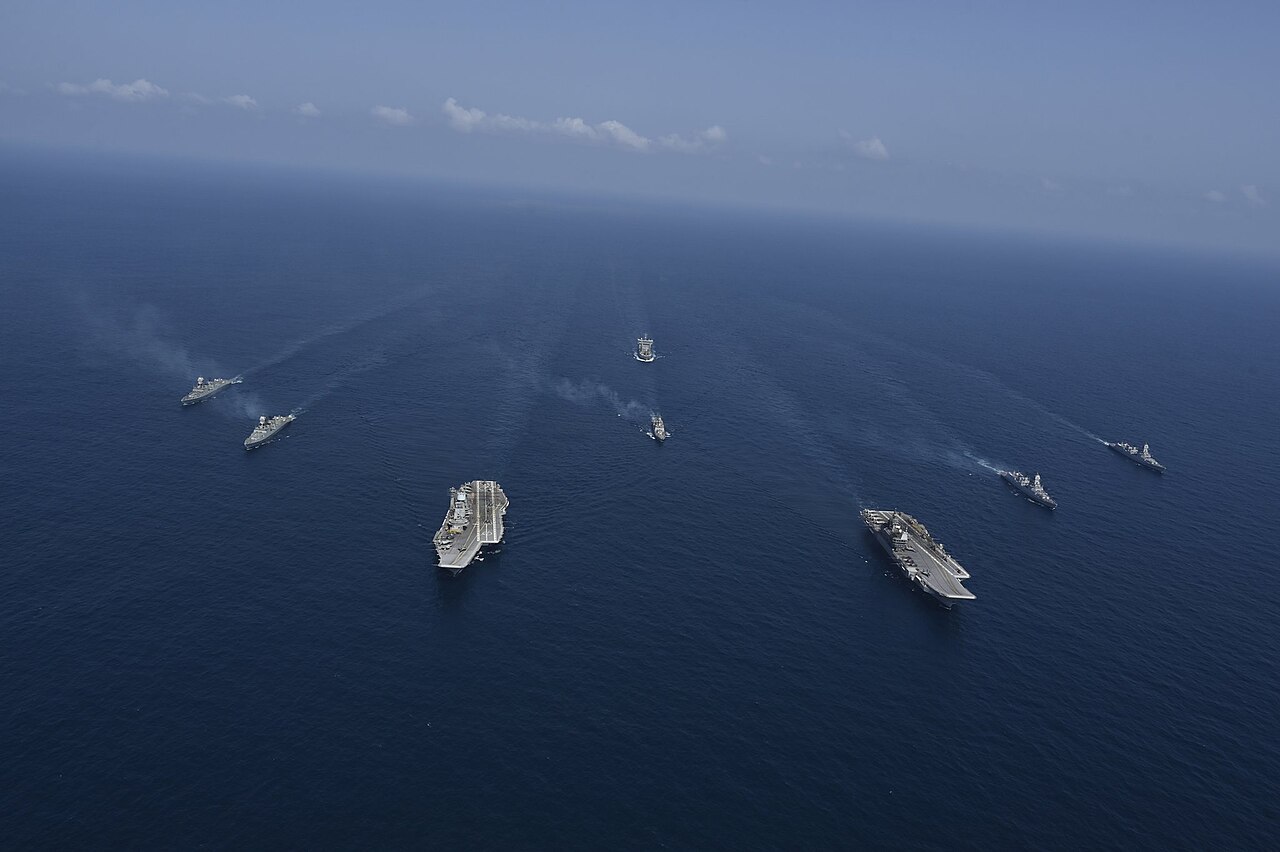
There is no more potent symbol of national power than an aircraft carrier. It is, in the most literal sense, a piece of a nation made mobile — a floating airfield, a hundred thousand tonnes of sovereign steel that can sail to any ocean on earth and project military power from international waters without asking anyone's permission. Where it goes, an air force goes with it; where it sails, a nation's reach follows. To build and operate carriers is to declare oneself a power with interests and ambitions that extend far beyond one's own shores.
India has made that declaration. It is one of the very few nations on earth to operate aircraft carriers, and rarer still, one of the even smaller group able to build them at home. From the first Vikrant that helped win the 1971 war, through the refurbished Russian carrier that became Vikramaditya, to the indigenous Vikrant launched from an Indian shipyard, the story of India's carriers is the story of its transformation from a modest coastal force into a genuine blue-water navy — one able to sail, fight and sustain itself across the great oceans. But that story is also one of hard debate: over whether carriers, magnificent and enormously expensive, are worth their cost in an age of missiles and submarines that can sink them. This is the story of India's steel islands, the arguments they provoke, and the two-ocean navy they are meant to build.
What a carrier is for
To grasp the debate over carriers, one must first understand what they are for, because their value is often misunderstood. An aircraft carrier is not, primarily, a ship that fights other ships; it is a mobile air base — a means of taking air power to places where a nation has no land airfield, and of keeping it there. The aircraft the carrier launches are its weapon: they can strike targets on land or sea, defend a fleet from attack, provide reconnaissance across vast distances, and control the air over a region far from home. The carrier itself is the enabler, the floating foundation that makes distant, sustained air power possible.[1]
This capability — power projection, in the language of strategists — is what makes carriers so valuable to a nation with interests far from its shores. A carrier battle group can sail to a distant crisis, establish a commanding military presence, and project air power ashore or at sea, all from international waters, without needing bases or overflight permissions from other countries. It is diplomacy and deterrence made mobile: the arrival of a carrier off a distant coast is a statement of intent that every government understands, and the ability to project force where no land base exists is a capability that only carriers provide.
For India, with its vast maritime interests, its dependence on distant sea lanes, and its ambition to be the preeminent power in the Indian Ocean and a player beyond it, this capability is genuinely valuable. A carrier lets India establish air superiority over a distant stretch of ocean, protect its shipping and its citizens far from home, respond to crises across a huge maritime expanse, and demonstrate the reach and resolve of a major power. The carrier is the instrument of a navy that thinks not in terms of defending its own coast but of shaping events across the oceans — and it is precisely this ambition that India's carriers are meant to serve.
The great debate: carriers versus submarines
Yet carriers are among the most contested investments in all of defence, and no discussion of them is honest without confronting the powerful case against them. The core of the argument is vulnerability. An aircraft carrier is enormous, expensive and, in an age of advanced anti-ship missiles, submarines and drones, potentially vulnerable to being found and sunk. A single carrier concentrates an immense fraction of a navy's resources and prestige in one hull, and the loss of that hull — to a missile, a torpedo, or a swarm of drones — would be a catastrophe both military and symbolic. Critics argue that carriers are increasingly floating targets, too valuable to risk and too vulnerable to survive against a capable adversary.[2]
The alternative these critics favour is the submarine. A submarine, hidden in the depths, is far harder to find and sink than a carrier; it can threaten an enemy's ships and coast from concealment, project a deadly and survivable form of power, and do so at a fraction of a carrier's cost. For the price of one carrier and its air wing and escorts, a navy could buy many submarines, and in an age where stealth is survival, some strategists argue that the future of sea power lies beneath the waves rather than upon them. Why, they ask, build vast vulnerable targets when hidden submarines offer more survivable power for less money?
The counter-argument is that submarines and carriers do different things, and that one cannot substitute for the other. A submarine can sink ships and threaten a coast, but it cannot project air power ashore, cannot establish air superiority over a region, cannot provide the visible presence and reach that a carrier offers, and cannot perform the humanitarian and diplomatic roles a carrier can. The carrier's air wing is a flexible instrument that a submarine simply cannot replicate. The honest resolution is that a balanced navy needs both — submarines for stealthy, survivable striking power, and carriers for mobile air power and presence — and the real debate is about the balance between them, not a simple choice of one over the other. India, in building both carriers and submarines, has come down on the side of a balanced fleet, but the debate over how much to invest in each remains live and consequential.
The first Vikrant and the birth of Indian carrier aviation
India's carrier story begins remarkably early, in the first decades of independence, with the acquisition of its first aircraft carrier — the original INS Vikrant, a British-built ship that entered Indian service in the early 1960s. That India, a young and poor nation, chose to acquire a carrier so early speaks to an early appreciation of sea power and of the reach that carrier aviation provides. The first Vikrant made India one of the few nations in Asia to operate an aircraft carrier, and it established the foundations of Indian naval aviation.[3]
The first Vikrant earned its place in history during the 1971 war that led to the birth of Bangladesh, when its aircraft played a significant role in the maritime campaign, striking targets and helping to establish Indian control of the waters of the eastern theatre. This combat service demonstrated the value of carrier aviation in a real war and cemented the carrier's place in Indian naval thinking. The Vikrant became a symbol of Indian sea power and a source of national pride, and its wartime service provided a concrete demonstration of what a carrier could contribute.
The legacy of the first Vikrant runs deep in the Indian Navy, which is why its name was later given to India's first indigenously built carrier — a deliberate act of continuity, linking the new ship to the proud history of the old. The first Vikrant established that India would be a carrier-operating navy, built the initial expertise in the demanding art of carrier aviation, and proved the carrier's worth in combat. It was the beginning of a tradition of Indian carrier operations that has continued, with various ships, ever since — a tradition that would eventually lead to India building carriers of its own.
Vikramaditya: a carrier reborn
For years India operated ageing carriers acquired abroad, and as these approached the end of their lives, it sought replacements. One major acquisition was the ship that became INS Vikramaditya — originally a Soviet-era carrier that India acquired and had extensively rebuilt and modernised, transforming an old vessel into a capable modern carrier. The Vikramaditya, a large carrier operating modern fighters, significantly enhanced India's carrier capability and became a centrepiece of the fleet.[4]
The Vikramaditya's acquisition was not without difficulty — the refurbishment was complex, delayed and costly, and the process illustrated the challenges of acquiring and modernising a major warship from abroad. But the result was a genuinely capable carrier that gave India a powerful instrument of air power at sea, able to operate a substantial air wing of modern fighters and to project force across the Indian Ocean. The Vikramaditya demonstrated India's continuing commitment to carrier aviation and provided the fleet with a modern flagship.
Yet the Vikramaditya, like the imported fighters of the Air Force, underscored the limits of acquiring one's major platforms abroad — the delays, the costs, the dependence on foreign yards and suppliers, the lack of full control over one's own capability. A navy that must buy or rebuild its carriers abroad remains dependent on others for its most prestigious and powerful ships. This dependence was precisely what India sought to escape, and even as the Vikramaditya joined the fleet, a far more significant project was under way — the construction, in an Indian shipyard, of a carrier that India would build itself.
The indigenous Vikrant: a nation builds its own carrier
The crowning achievement of India's carrier ambition is the new INS Vikrant — the first aircraft carrier ever designed and built in India, named in honour of its illustrious predecessor. Constructed at an Indian shipyard over many years, the indigenous Vikrant made India one of a very small group of nations in the world capable of building an aircraft carrier at home — an elite club that includes only a handful of the most advanced naval powers. Its commissioning was a landmark moment, a demonstration that India could build the most complex and prestigious of all warships with its own hands.[3]
The significance of building a carrier indigenously is hard to overstate. An aircraft carrier is arguably the most complex machine a nation can build — a floating city and airfield combining propulsion, aviation facilities, weapons, sensors, and accommodation for thousands, integrated into a single vast and sophisticated warship. To build one requires mastering an enormous range of technologies and industrial skills, coordinating a huge and complex construction effort, and solving countless engineering challenges. That India accomplished this, over years of effort and despite the difficulties, is a genuine triumph of its shipbuilding industry and a powerful demonstration of national capability.
The indigenous Vikrant is more than a ship; it is proof of a capability and a foundation for the future. Having built one carrier, India has accumulated the skills, the infrastructure and the confidence to build more, and the knowledge gained flows into the broader shipbuilding industry and the wider goal of self-reliance. The Vikrant embodies the transformation of India from a nation that bought its carriers abroad to one that builds them at home — a transformation that gives India control over its own sea power and places it among the world's foremost naval-industrial powers. It is, quite literally, a steel island of India's own making.
Building the impossible: the Cochin achievement
The construction of the indigenous Vikrant deserves recognition as one of the great feats of Indian industry, for building an aircraft carrier from scratch tested the limits of the nation's shipbuilding capability. The project required the development of specialised steel that India learned to produce domestically, the mastery of complex construction and integration techniques, the coordination of a vast network of suppliers and subsystems, and the solving of the countless problems that arise in building so complex a warship for the first time.[3]
The effort was long and difficult, marked by the delays and challenges that attend any first-of-its-kind project of such complexity. Building a carrier is not like building a smaller warship; the scale, the aviation facilities, the integration of systems, and the sheer complexity present challenges of an entirely different order, and doing it for the first time meant learning as the ship was built. That the project succeeded, delivering a genuine operational carrier, is a testament to the skill and persistence of India's naval architects, shipbuilders and engineers.
The industrial legacy of the achievement extends far beyond the ship itself. In building the Vikrant, India developed capabilities — in specialised materials, in complex construction, in systems integration, in project management — that strengthen its entire shipbuilding and defence-industrial base. The suppliers and skills developed for the carrier feed into other naval and industrial projects, and the confidence gained encourages further ambition. Like the Tejas in the air, the Vikrant at sea was as much about building the capability to build as about the platform itself, and that capability is a national asset that will pay dividends for decades.
The third carrier debate
With one indigenous carrier built and another modernised carrier in service, India faces a consequential decision: whether to build a third carrier, larger and more capable, to sustain and expand its carrier fleet. This debate — over the proposed second indigenous carrier, sometimes called IAC-2 — captures in miniature the whole argument over carriers and their place in India's naval future, and it has been the subject of intense discussion among planners and strategists.[2]
The case for a third carrier rests on the logic of numbers and continuous availability. Carriers, like all warships, require periodic maintenance and refit, during which they are unavailable; with only two carriers, there may be times when only one, or even none, is operationally available. A three-carrier fleet would allow India to keep at least one, and often two, carriers available at all times, and to maintain a carrier presence in both the Arabian Sea and the Bay of Bengal — a two-ocean capability befitting India's maritime ambitions. Proponents argue that carrier aviation is central to India's power-projection and sea-control ambitions, and that a larger, more capable third carrier is essential to realising them.
The case against, or for caution, rests on cost and vulnerability. A large carrier and its air wing and escorts represent an enormous investment — resources that could buy many submarines, aircraft, or other capabilities. In an age of advancing anti-ship missiles and undersea threats, sceptics question whether concentrating so much in additional carriers is the wisest use of finite funds, and whether submarines and other systems might offer more survivable power for the money. The third-carrier debate is thus a debate about India's naval priorities and its vision of future sea power — carrier-centric power projection versus a more distributed, submarine-heavy fleet — and how it is resolved will shape the Indian Navy for a generation.
The fighters that fly from the deck
A carrier is only as capable as the aircraft it operates, and here India faces both a present reliance on imports and an indigenous ambition that mirrors its broader air-power story. The current carrier air wing centres on the MiG-29K, a navalised version of a Russian fighter, capable but imported, with all the dependencies that implies. Operating fighters from a carrier deck is among the most demanding forms of aviation — the aircraft must be strengthened for the violent forces of catapult or ski-jump launches and arrested landings, and specially adapted for the maritime environment — and India has relied on foreign designs for this exacting role.[1]
The indigenous answer is the Twin-Engine Deck-Based Fighter, or TEDBF — a carrier-borne fighter that India is developing to operate from its carriers, drawing on the design capability built through the Tejas programme. A twin-engine fighter offers the power and redundancy valued for carrier operations, and an indigenous deck fighter would free India from dependence on foreign carrier aircraft, allowing it to build, arm and sustain its carrier air wings at home. The TEDBF represents the extension of India's indigenous fighter ambition to the demanding realm of carrier aviation.
The challenge is considerable, for carrier aviation adds a whole layer of difficulty to the already-hard task of building a fighter. The aircraft must withstand the stresses of deck operations, fit within the constraints of a carrier's limited space, and integrate with the carrier's launch and recovery systems, all while remaining a capable combat aircraft. Developing such a fighter indigenously, and getting it into service in time to equip India's carriers, is a demanding undertaking — but it is the logical and necessary complement to building the carriers themselves, for a carrier flying imported fighters is only partly sovereign. The goal, as with the Air Force, is a carrier force that is Indian from the hull to the aircraft on its deck.
The battle group: a carrier never sails alone
A carrier is never sent to sea by itself, for it would be far too vulnerable; it sails at the centre of a carrier battle group, a task force of warships and submarines whose collective job is to protect the carrier and extend its reach. This escort force — destroyers and frigates bristling with air-defence missiles and sensors, anti-submarine vessels and helicopters, supply ships and often a submarine — forms a layered shield around the carrier, defending it from air, surface and undersea threats and allowing it to operate safely in contested waters.[5]
The carrier battle group is thus a system, not a single ship, and its effectiveness depends on the quality and integration of all its parts. India has invested heavily in the escorts a carrier group requires, building modern destroyers and frigates — many of them indigenously — equipped with advanced air-defence systems, sensors and weapons capable of protecting the group from the missiles, aircraft and submarines that might threaten the carrier. The development of these capable escorts is as important to India's carrier ambition as the carriers themselves, for without them the carrier cannot safely operate.
This systemic nature of carrier operations connects to the broader transformation of the Indian Navy, because building carrier battle groups requires building a whole balanced fleet — the carriers, the escorts, the submarines, the supply ships, the aircraft, and the networks that tie them together. A navy that can field and operate carrier battle groups is, by definition, a capable and balanced blue-water force, and India's investment in the full range of these capabilities reflects its ambition to be exactly that. The carrier is the centrepiece, but the battle group is the achievement, and the battle group is a microcosm of the modern navy India is building.
From brown water to blue
The carriers and their battle groups are the most visible expression of a deeper transformation: the evolution of the Indian Navy from a modest coastal force into a genuine blue-water navy capable of operating across the great oceans. For much of its history, the Indian Navy was necessarily focused on defending the nation's coasts and immediate waters — a "brown-water" or at most "green-water" force with limited ability to operate far from home for extended periods. The transformation into a blue-water navy, able to sail, fight and sustain itself across distant oceans, has been one of the quiet epics of India's military development.[5]
A blue-water navy requires a whole architecture of reach beyond the fighting ships themselves: replenishment vessels to refuel and resupply the fleet at sea, allowing it to remain far from home for months; maritime patrol aircraft to extend surveillance across vast expanses; the logistics, communications and support to sustain distant operations; and the doctrine, training and experience to operate as a coherent force across the oceans. Building all of this, over decades, has been as important as building the carriers and warships, and it is what allows India to project power far from its shores.
The recent demonstrations of this blue-water capability — sustained deployments to distant waters, operations far from home to protect shipping and interests — have shown how far the transformation has progressed. The Indian Navy can now do what a blue-water navy must: deploy substantial forces across the oceans, sustain them there, and use them to protect national interests at a distance. The carriers are the flagships of this transformed navy, but the transformation runs far deeper, encompassing the whole fleet and the whole architecture of reach that makes distant sea power possible. India has become, unmistakably, a blue-water naval power.
The indigenous fleet
Underpinning the blue-water navy is a shipbuilding achievement that extends far beyond the carriers: India's growing ability to design and build its warships at home. Across classes of vessels — destroyers, frigates, corvettes, submarines and now carriers — India has increasingly built its own ships in its own yards, developing one of the more capable naval shipbuilding industries in the world and steadily reducing its dependence on foreign suppliers for its fleet.[5]
This indigenous shipbuilding capability is a strategic asset of the first order. A navy that builds its own ships controls its own sea power — it is not dependent on foreign yards and suppliers, not vulnerable to having its shipbuilding cut off, and able to build, maintain and improve its fleet on its own terms. The industrial base that builds warships also accumulates capabilities that strengthen the broader economy and the wider defence industry, and it provides the foundation for further growth and even for exporting warships to friendly nations, as India has begun to do.
The indigenous fleet also embodies the self-reliance that runs as a theme through all of India's defence efforts. Just as it seeks to build its own fighters, missiles and submarines, India seeks to build its own surface warships, and it has come further in naval shipbuilding than in many other domains — its warship-building industry is genuinely capable and increasingly self-sufficient. The carriers are the crowning achievement, but the whole indigenous fleet — the destroyers and frigates that escort them, the submarines that complement them, the supply ships that sustain them — represents the maturation of India's ability to build the sea power it needs at home.
The Indian Ocean and the China challenge
India's carrier and naval ambitions unfold against the strategic backdrop of the Indian Ocean and the growing challenge of China's expanding naval power. The Indian Ocean, which bears India's name, is among the most strategically vital bodies of water on earth — the highway for much of the world's energy and trade — and India has long aspired to be its preeminent security provider. But that aspiration is increasingly contested, as China builds the world's largest navy and extends its reach into the Indian Ocean, establishing bases and presence and challenging India's position in its own maritime backyard.[2]
China's naval expansion is the central strategic fact shaping India's sea-power efforts. In a remarkably short time, China has built a navy of enormous size and growing capability, including its own aircraft carriers, and has extended its operations far beyond its own waters, including into the Indian Ocean. This growing Chinese presence in what India regards as its strategic backyard is a profound challenge, and it drives India's determination to build the naval power — carriers, submarines, warships and the whole blue-water architecture — needed to hold its own and maintain its position.
The carriers are central to this contest, for they give India the mobile air power and presence to contest control of the Indian Ocean and to project force across it. In a competition with a rival building carriers and extending its naval reach, India cannot cede the field; it must field comparable capabilities of its own, and the carrier is a key instrument of maritime influence and power projection. The China challenge, more than anything, is what makes India's carrier and naval ambitions strategically compelling, and it is against this backdrop that the debates over carriers, submarines and priorities must ultimately be judged — for the stakes are India's position in its own ocean and its standing as a maritime power.
The two-ocean navy
India's ultimate naval ambition can be captured in a phrase: a two-ocean navy, able to maintain a powerful presence in both the Arabian Sea to the west and the Bay of Bengal to the east, and to project power across the whole Indian Ocean and beyond. This ambition reflects India's geography — a peninsula thrusting into the Indian Ocean, with vast coastlines and interests on both sides — and its aspiration to be the dominant naval power in its own maritime region.[5]
Achieving a two-ocean capability is precisely what drives much of India's naval building, including the debate over a third carrier. To maintain a strong presence in both oceans simultaneously requires enough ships, carriers and submarines to cover both theatres, accounting for the vessels always unavailable due to maintenance and refit. It requires the bases, the logistics and the reach to operate across the whole expanse, and the fleet strength to do so while retaining a reserve. The two-ocean ambition sets the scale of the navy India seeks to build, and it explains why India continues to invest so heavily in expanding its fleet.
The two-ocean navy is also a statement of strategic intent — a declaration that India intends to be the preeminent power across the Indian Ocean, able to secure its interests, protect its sea lanes, reassure its partners and deter its rivals throughout the region. It is an ambition commensurate with India's size, its interests and its aspirations to great-power status, and the carriers are among its most important instruments. Whether India fully achieves the two-ocean navy will depend on the resources it commits and the choices it makes among competing priorities, but the ambition is clear, and the carriers and the blue-water fleet are the means by which India intends to realise it.
Beneath the fleet: the submarine complement
A balanced navy pairs its surface fleet with a capable submarine force, and India's carriers and warships are complemented by submarines that provide the stealthy, survivable striking power that surface ships cannot. The submarine force ranges from conventional diesel-electric boats that guard India's waters to nuclear-powered submarines, including the strategic missile boats that carry India's sea-based nuclear deterrent and the attack submarines that hunt an enemy's ships and submarines. Together, the surface fleet and the submarine force form the two complementary halves of a complete navy.[5]
The relationship between the carriers and the submarines is not one of rivalry, as the carrier-versus-submarine debate sometimes implies, but of complementarity in a balanced fleet. The carriers provide mobile air power, presence and power projection; the submarines provide stealthy, survivable striking power and the ultimate sea-based deterrent. A carrier battle group often includes a submarine among its escorts, hunting for enemy submarines and extending the group's reach, and the two types work together as parts of an integrated force. India's investment in both reflects the judgment that a great navy needs the full range of capabilities.
The submarine dimension also connects the navy to India's nuclear deterrent, for the nuclear-armed ballistic-missile submarines form the most survivable leg of the nuclear triad — the hidden boats that guarantee India could retaliate even after a devastating first strike. This strategic role gives the submarine force a significance beyond conventional naval operations, and it underscores that the navy India is building serves not only to project power and control the seas but to underwrite the nation's ultimate deterrent. The carriers may be the most visible symbols of Indian sea power, but the submarines beneath the waves carry some of its heaviest strategic responsibilities, and together they form the balanced fleet that India's ambitions require.
Over the horizon: the naval air arm
Carrier aviation is the most glamorous part of naval air power, but the navy's aircraft extend far beyond the carrier deck, and this broader naval air arm is a vital part of India's sea power. Long-range maritime patrol aircraft, flying from land bases, watch vast stretches of ocean, hunting for submarines, tracking surface ships, and providing the surveillance that lets the navy see across its enormous area of responsibility. These aircraft, equipped with advanced sensors and weapons, are among the most valuable assets in maritime warfare, extending the navy's eyes and reach far beyond its ships.[6]
India has invested in capable maritime patrol aircraft, giving it the ability to monitor the vast expanses of the Indian Ocean, detect and track submarines and surface vessels, and respond to threats across a huge area. In an ocean where outside powers increasingly operate, including with submarines, this surveillance capability is crucial, for a navy that cannot see cannot respond, and the ability to detect and track potential threats across the ocean is fundamental to maintaining maritime awareness and control. The maritime patrol fleet is a force multiplier of enormous value, extending the navy's reach far beyond the horizon of its ships.
The naval air arm also includes the helicopters that fly from warships — hunting submarines, extending the ships' sensors and reach, and providing utility and rescue capabilities — and the various aircraft that support naval operations. Together with the carrier-borne fighters, these aircraft give the navy a rounded air capability that is essential to modern sea power, for the aircraft are often the navy's most effective sensors and weapons, able to search vast areas and strike at a distance. India's investment across the naval air arm, from carrier fighters to maritime patrol aircraft to shipborne helicopters, reflects the central role of aviation in contemporary naval warfare and strengthens the whole fabric of Indian sea power.
The carrier-killer threat
The case against carriers rests heavily on the growing threat of weapons designed specifically to sink them, and this "carrier-killer" threat deserves examination, for it shapes both the debate over carriers and the way they must be protected. Adversaries have developed, and continue to develop, an array of weapons aimed at the carrier: long-range anti-ship missiles, including advanced and even hypersonic ones designed to overwhelm a carrier's defences; submarines that can approach and strike with torpedoes and missiles; and, increasingly, drones and unmanned systems that can threaten ships. The proliferation of these weapons is the strongest argument that carriers are vulnerable.[2]
The threat is real and growing, and it cannot be dismissed. A carrier that can be found and struck by a long-range missile or a submarine is a carrier at risk, and the development of ever-more-capable anti-ship weapons — particularly the fast, manoeuvring, hard-to-intercept hypersonic missiles — poses a genuine challenge to the survivability of surface ships, carriers most of all. An adversary with a robust array of such weapons could, in principle, hold a carrier at risk across a wide area, complicating its operations and threatening its survival. This is the crux of the vulnerability argument, and it is a serious one.
The response is layered defence and careful operation. A carrier does not sail alone but at the centre of a battle group whose escorts provide layers of defence against missiles, aircraft and submarines, and whose sensors and electronic warfare help detect and defeat incoming threats. Carriers operate with awareness of the threat, using their mobility and the ocean's vastness to complicate an enemy's targeting, and staying beyond the reach of the most dangerous threats where possible. The contest between the carrier and the weapons designed to sink it is a genuine one, and its outcome shapes the value of carriers; India's carriers must be protected by capable escorts and defences, and the carrier-killer threat is a central consideration in how they are built, escorted and employed. It is the strongest argument for caution, and it must be answered by defence, not ignored.
The 1971 war: sea power proven
India's conviction about the value of sea power, and of carriers in particular, was forged partly in the crucible of the 1971 war, in which the Indian Navy played a decisive and celebrated role. In that conflict, the navy demonstrated the value of sea power in a way that shaped its ambitions ever after — mounting daring attacks on the enemy's principal port, establishing control of the seas around the theatre of war, and using its carrier's aircraft to strike targets and support the campaign that led to a decisive victory and the birth of Bangladesh.[5]
The naval operations of 1971 became legendary in Indian military history — bold missile attacks that struck the enemy's harbour and ships, the establishment of maritime dominance, and the contribution of carrier aviation to the eastern campaign. These operations demonstrated concretely what sea power could achieve: control of the seas, the projection of force against the enemy's coast and shipping, and a significant contribution to a decisive national victory. The navy emerged from the war with enormous prestige and a proven record, and the experience cemented the conviction that a capable navy, including carrier aviation, was a vital instrument of national power.
The legacy of 1971 runs deep in Indian naval thinking and helps explain the navy's enduring commitment to carriers and to blue-water capability. The war proved that sea power mattered, that it could shape the outcome of conflicts, and that carrier aviation had a valuable role to play — lessons that have informed India's naval ambitions ever since. The victory of 1971 is a source of pride and a foundation of doctrine, a demonstration in war of the value of the sea power that India has continued to build, and a reminder that the carriers and warships are not symbols alone but instruments proven in the decisive test of combat.
Amphibious power and the reach ashore
A capable navy provides not only control of the seas and power projection through aircraft but the ability to project force onto land — to land troops and equipment on a hostile or friendly shore, a capability known as amphibious warfare. This capability extends a navy's reach from the sea onto the land, allowing it to seize territory, reinforce distant positions, respond to crises, and deliver humanitarian assistance where ports and airfields are unavailable. Amphibious ships — large vessels that can carry troops, vehicles and landing craft — are the instruments of this capability.[6]
India has invested in amphibious capability, operating ships that can land forces ashore and pursuing the development of larger and more capable amphibious vessels. This capability serves multiple purposes: it strengthens the navy's ability to project force in war, to reinforce and supply India's island territories and distant positions, and to respond to humanitarian crises across the region, delivering aid and relief where it is needed. The amphibious fleet extends India's reach and flexibility, giving it options that a navy of warships and submarines alone could not provide.
The amphibious dimension connects to India's broader maritime strategy and its role across the Indian Ocean, for the ability to reach and influence distant shores is central to being a regional power. Whether reinforcing island territories, responding to a crisis in a neighbouring state, delivering disaster relief, or projecting force in conflict, the amphibious capability gives India instruments of reach and influence that complement its carriers and warships. It is a further dimension of the blue-water navy India is building — a navy able not only to control the seas but to project its power and its assistance onto the land across its vast maritime region.
The infrastructure of sea power
A navy is more than its ships; it depends on a vast infrastructure of bases, ports, repair yards, logistics and support that enables the fleet to operate, and building this infrastructure is as important as building the ships themselves. India has invested in developing its naval bases and supporting infrastructure, including major bases that provide the fleet with the facilities it needs to operate, maintain and sustain its ships, and strategic positions that extend the navy's reach across its maritime region.[5]
The importance of this infrastructure grows with the ambition of the navy, for a blue-water fleet operating across the oceans requires bases and support both at home and, increasingly, access to facilities across the region. India has worked to develop its own bases and to build relationships and arrangements that provide access to ports and facilities across the Indian Ocean, extending the reach and sustainability of its fleet. This network of bases and access is a crucial if unglamorous foundation of sea power, for a navy that cannot base, repair and resupply its ships across its area of operations cannot sustain a blue-water presence.
India's island territories, in particular, provide strategically valuable positions that extend its reach and awareness across vital waters, including the approaches to crucial chokepoints. Developing the infrastructure on these islands, and using them as bases for surveillance and operations, strengthens India's position across the Indian Ocean and enhances its ability to monitor and influence the vital sea lanes. The infrastructure of sea power — the bases, the ports, the island positions, the logistics and support — is the foundation on which the fleet operates, and India's investment in it is essential to realising its blue-water and two-ocean ambitions.
Networked warfare at sea
Modern naval warfare, like war on land and in the air, is increasingly defined by networks — by the linking together of ships, submarines, aircraft, sensors and command centres into an integrated whole that can share information and act in concert. A fleet whose units are networked, sharing a common picture of the battlespace and coordinating their actions, is far more effective than one whose units fight in isolation, and building this networked capability is central to modern sea power.[6]
India has invested in the networks and systems that link its naval forces, enabling its ships, submarines, aircraft and shore establishments to share information and coordinate their operations. This networking multiplies the effectiveness of the fleet, allowing its units to act as an integrated force, to concentrate their effects, and to respond quickly and coherently to threats and opportunities. The maritime surveillance and information networks that fuse data from many sources into a common picture of the vast ocean are particularly valuable, for they give the navy the awareness on which effective operations depend.
This networked dimension connects naval power to the broader transformation of warfare toward integration and information dominance, and to India's efforts across the domains of cyber, space and jointness. A modern navy is a networked navy, and its effectiveness depends increasingly on the quality of its networks and its ability to gather, share and act on information faster than its adversaries. India's investment in networked naval warfare, alongside its ships and aircraft, reflects the recognition that sea power in the twenty-first century is as much about information and integration as about hulls and guns, and it strengthens the whole fabric of the fleet India is building.
The nuclear propulsion question
As India contemplates the future of its carriers, one significant question concerns propulsion — specifically, whether future carriers should be nuclear-powered, as the largest and most capable carriers of the world's foremost naval power are. Nuclear propulsion offers a carrier enormous advantages: effectively unlimited range and endurance, freedom from the need to refuel, and the ability to generate the vast power that the most advanced carrier systems require. But it also brings great complexity, cost and technological demands.[3]
The question of nuclear propulsion for carriers connects to India's broader mastery of nuclear propulsion, which it has developed for its submarines. Having built nuclear-powered submarines, India possesses the foundations of the technology, and the possibility of nuclear-powered carriers is part of the discussion about the future of its carrier fleet, particularly for larger and more capable future carriers. A nuclear-powered carrier would offer the range, endurance and power-generation that the most advanced carrier operations demand, extending India's reach and capability.
Whether India pursues nuclear propulsion for future carriers is one of the many decisions that will shape its carrier fleet in the decades ahead, involving trade-offs of cost, complexity and capability. A nuclear-powered carrier would be enormously capable but enormously demanding to build and operate; a conventionally powered one is more achievable but more limited. This question, like the broader debate over the third carrier and the balance of the fleet, reflects the many choices India faces as it builds its future sea power — choices about how ambitious, how capable, and how expensive its carriers should be, and about the kind of naval power it seeks to become.
Sea control and sea denial
Naval strategy turns on two related but distinct concepts that shape how India thinks about its carriers and its fleet: sea control and sea denial. Sea control is the ability to use a stretch of ocean for one's own purposes — to move shipping, project power and operate freely — while denying that use to the enemy; it is the positive command of the sea that a strong navy seeks. Sea denial is the more limited ability to prevent an enemy from using a stretch of ocean, without necessarily being able to use it freely oneself; it is what a weaker navy, or one relying on submarines and missiles, may aim for.[2]
The distinction matters for India's fleet design and for the carrier debate, because carriers are instruments of sea control — they project power and command the sea and air over a region — while submarines and missiles are often instruments of sea denial, able to threaten and deny without commanding. A navy that seeks to control the seas, to use them freely for its own purposes and to project power across them, needs the sea-control capabilities that carriers provide; a navy content to deny the seas to an enemy might rely more on submarines and missiles. India's investment in carriers reflects an ambition for sea control, not merely sea denial — an ambition to command the Indian Ocean and project power across it, not simply to deny it to others.
This ambition for sea control is commensurate with India's aspiration to be the preeminent power in the Indian Ocean, for a nation that seeks to shape events across a maritime region, protect its sea lanes, reassure its partners and deter its rivals must be able to control the seas, not merely deny them. The carriers, the blue-water fleet, and the whole architecture of Indian sea power are instruments of this ambition for command of the ocean. The choice between prioritising sea control and sea denial — between a carrier-centric fleet and a submarine-centric one — is, at bottom, a choice about how ambitious India's maritime aims are, and India's investment in carriers reflects the larger ambition of a power that seeks to command its ocean.
The marine commandos and special operations at sea
Beyond the great ships and submarines, a modern navy fields elite forces capable of specialised operations at and from the sea — the marine commandos and naval special forces who conduct missions of great difficulty and danger. These forces can board and seize vessels, conduct raids on hostile shores, gather intelligence, rescue hostages, and carry out the demanding special operations that the maritime environment sometimes requires, providing the navy with a flexible and precise instrument distinct from the firepower of its ships.[6]
India's naval special forces have demonstrated their value in operations ranging from counter-piracy — boarding and retaking hijacked vessels and freeing captured crews — to counter-terrorism and other demanding missions. In the anti-piracy operations of recent years, these elite forces played a crucial role, conducting the boardings and actions that freed hijacked ships and their crews, demonstrating both their skill and the navy's ability to act precisely and decisively. Such forces provide capabilities that the navy's ships and aircraft cannot, extending its reach into the realm of special operations.
The importance of these forces has grown with the changing character of maritime security, in which threats such as piracy, terrorism and unconventional challenges increasingly feature alongside traditional naval warfare. The ability to conduct precise, specialised operations — to board a suspicious vessel, retake a hijacked ship, or conduct a raid — is increasingly valuable in a maritime environment shaped by these unconventional threats, and India's naval special forces provide it. They are a small but vital part of the navy's capabilities, embodying the skill, courage and precision that the most demanding maritime missions require, and adding a flexible instrument to India's sea power that complements the firepower of its great ships.
Exporting sea power
As India's naval shipbuilding capability has matured, a new dimension has emerged that reflects how far the industry has come: the export of warships and naval capability to friendly nations. India's shipyards, having grown genuinely capable, have built and exported patrol vessels and other craft to friendly navies, and India offers a range of naval platforms and capabilities for export, seeking to become not only a builder of its own sea power but a supplier of maritime capability to others.[5]
The export of warships carries significance beyond the commercial, for it validates India's shipbuilding capability, deepens the industrial base by expanding production beyond domestic needs, and builds the strategic relationships that arms sales create. When India builds and exports vessels to friendly navies across its region, it strengthens those navies, deepens its partnerships with the recipient nations, and positions itself as a maritime security partner across the Indian Ocean. The export of sea power is thus an instrument of India's broader maritime strategy and its ambition to be the preeminent power in its region, as well as a source of revenue and industrial strength.
The capacity to export warships also reflects the broader maturation of India's naval-industrial base, which has become one of the more capable in the world, able to build vessels ranging from patrol craft to warships to an aircraft carrier. This industrial strength is a strategic asset that both underpins India's own sea power and allows it to strengthen the navies of its partners, extending its influence and building relationships across the region. The export of sea power, like the export of India's other defence capabilities, is part of the larger story of a nation building the capability to arm itself and its friends, and it is a measure of how far India's naval-industrial capability has come.
The guardian in the grey zone
Increasingly, the challenges a navy faces are not the clear-cut battles of traditional war but the ambiguous threats of the "grey zone" — the piracy, smuggling, terrorism, unregulated fishing, and coercive but sub-war activities that fill the space between peace and open conflict. These challenges require a navy able not only to fight wars but to police the seas, to maintain maritime order, and to respond to the varied and often ambiguous threats that arise across its waters in peacetime and in the twilight between peace and war.[6]
India's navy has increasingly taken on these grey-zone roles, protecting shipping against piracy, countering smuggling and trafficking, maintaining maritime domain awareness to detect suspicious activity, and responding to the varied threats that arise across its vast maritime region. The Red Sea crisis, with its mix of missile and drone attacks and resurgent piracy, exemplified the kind of ambiguous, sub-war challenge that modern navies must handle, and India's response — protecting shipping, countering piracy, and maintaining a presence — demonstrated its ability to act across the grey zone. This capacity to police the seas and maintain order, not only to fight wars, is an increasingly important part of sea power.
The grey-zone role connects to India's conception of itself as a provider of maritime security and order across the Indian Ocean, for maintaining the security of the seas requires the continuous presence and effort of a capable navy able to respond to the varied threats that arise. Whether protecting shipping, countering illicit activity, maintaining awareness of the maritime environment, or responding to crises, the navy serves as a guardian of maritime order, and this role is central to India's ambition to be the preeminent security provider in its ocean. The carriers and great ships may be built for war, but much of the navy's work is the constant, less dramatic task of guarding the seas and maintaining the order on which the region's security and prosperity depend.
Presence, diplomacy and the soft power of steel
Beyond their war-fighting role, carriers and the blue-water navy serve India in ways that are diplomatic and humanitarian, extending the nation's influence and goodwill across the oceans. A visit by an Indian carrier or task group to a friendly port is an act of diplomacy, deepening a relationship and demonstrating India's reach and capability. Joint exercises with other navies build partnerships, interoperability and trust. The mere presence of a capable Indian navy across the Indian Ocean reassures the region's smaller states and positions India as their natural security partner.[1]
The humanitarian role is particularly valuable and has repeatedly enhanced India's standing. The Indian Navy has often been a first responder to maritime disasters and crises across the region — evacuating citizens from conflict zones, delivering aid after natural disasters, rescuing sailors and vessels in distress. A blue-water navy with the reach to respond quickly to such emergencies across a vast region is an instrument of enormous soft power, building goodwill and demonstrating India's role as a responsible and capable regional leader. The same ships that can project military force can also deliver relief, and this dual capability multiplies the navy's strategic value.
This diplomatic and humanitarian dimension is central to India's conception of its naval role, which it frames not as domination but as the provision of security and stability — the "net security provider" for the Indian Ocean region. The carriers and the blue-water fleet are instruments of this benign leadership as much as of war-fighting, extending India's influence through presence, partnership and assistance rather than only through the threat of force. In an age when influence is contested across the Indian Ocean, this soft power of steel — the goodwill and standing that a capable and helpful navy provides — is among the most valuable returns on India's naval investment.
The cost and the hard choices
No account of India's carrier and naval ambitions is complete without confronting their cost, for sea power is enormously expensive, and the resources it consumes must be weighed against every other national priority. A carrier and its air wing and escorts represent one of the largest investments a nation can make in a single capability, and the blue-water navy as a whole — the ships, the submarines, the aircraft, the bases, the sustainment — absorbs a vast share of the defence budget. Every rupee spent on carriers is a rupee not spent on aircraft for the Air Force, on the Army's modernisation, or on other pressing needs.[2]
This is the hard reality behind the carrier debates: India's resources are finite, and its defence needs are vast and competing. The Air Force needs fighters to reverse its squadron crisis; the Army needs modernisation for its demanding frontiers; the nuclear deterrent must be sustained; and the Navy seeks carriers, submarines and a blue-water fleet. Balancing these competing claims, deciding how much to invest in sea power versus air and land power, and choosing among naval priorities — carriers versus submarines, more carriers versus more submarines and escorts — are among the hardest choices in Indian defence, and they involve genuine trade-offs with no easy answers.
The resolution India has broadly chosen is a balanced approach — investing in carriers and submarines and surface ships together, building a rounded blue-water navy rather than betting everything on one type of capability — while continually debating the balance among them and against the other services. This balance reflects a judgment that India's maritime interests and ambitions justify a capable and diverse navy, including carriers, even at great cost. But the debate over cost and priorities is permanent and legitimate, and it is a healthy sign of a nation thinking seriously about how to spend its finite resources on the security it needs. The carriers are magnificent and valuable, but they are also expensive, and the choices they force are real.
Fleet air defence: the layered shield at sea
A carrier battle group survives in contested waters through layered air defence — successive rings of protection that engage incoming threats at progressively closer ranges, so that anything penetrating the outer layer meets the next, and the next again. The outermost layer is the carrier's own aircraft, flying combat air patrols to intercept enemy aircraft and missiles far from the fleet; within that come the long-range air-defence missiles of the escorting destroyers and frigates, then medium and short-range systems, and finally the close-in weapons that form the last line of defence against any threat that reaches the ships themselves.[6]
India has invested heavily in the systems that provide this layered shield, equipping its warships with advanced air-defence missiles, sensors and close-in weapons capable of defending the fleet against the aircraft, missiles and drones that might threaten it. The development of capable indigenous and imported air-defence systems for its warships is essential to the survivability of the carrier battle group, for it is these layers of defence that allow the carrier to operate in the face of the anti-ship threats that critics rightly emphasise. The stronger and more integrated the layered defence, the better the carrier can survive and operate in contested waters, and India's investment in fleet air defence is thus central to the viability of its carriers.
The importance of layered fleet air defence has grown with the proliferation of anti-ship weapons, particularly the fast and manoeuvring missiles that pose the greatest threat to surface ships. As these threats advance, so must the defences, and the contest between the anti-ship weapons and the layered defences that counter them is a central dynamic of modern naval warfare. India's continued investment in advancing its fleet air defence — better missiles, better sensors, better integration, and increasingly the electronic warfare and directed-energy systems that can defeat cheap threats economically — is essential to keeping its carriers and warships survivable in the face of evolving threats. The layered shield is what makes sea power possible in a contested age, and building and advancing it is as important as building the ships it protects.
The island fortresses
India's maritime power rests not only on its ships but on its geography, and among its most valuable strategic assets are its island territories, which extend its reach and awareness across vital waters. These islands, positioned near crucial sea lanes and chokepoints through which much of the region's shipping must pass, provide India with permanent, unsinkable positions from which to monitor and, if necessary, influence the vital waters — a natural extension of its sea power that no adversary can remove.[5]
The strategic value of these island positions has grown as competition across the Indian Ocean has intensified, for they allow India to watch over the approaches to crucial chokepoints, to base surveillance and forces near the vital sea lanes, and to project awareness and influence across waters of great strategic importance. India has worked to develop the infrastructure and capabilities on these islands, using them as bases for surveillance and operations and strengthening its position across the eastern approaches to the Indian Ocean. The islands function as fixed complements to the mobile power of the fleet — permanent positions that anchor India's presence across vital waters.
The combination of the mobile power of the carriers and fleet with the fixed positions of the island territories gives India a strategic reach across the Indian Ocean that few other powers can match, anchoring its aspiration to be the preeminent power in the region. The island fortresses extend India's awareness and influence to waters far from its mainland, near the chokepoints through which the region's trade and energy must flow, and they enhance its ability to monitor and, if necessary, control the vital sea lanes. Together with the carriers and the blue-water fleet, they form the architecture of a maritime power that reaches across the whole of its ocean — a combination of steel islands that sail and stone islands that stand, extending India's power across the seas that bear its name.
Steel islands and the measure of a power
Step back from the debates over cost and vulnerability, and the carriers stand as a measure of what India has become and what it aspires to be. A nation that can build and operate aircraft carriers is, by that very fact, a major power — one with the industrial capability, the strategic ambition and the resources to field the most complex and powerful of all warships. India's carriers, and especially the indigenous Vikrant, are proof that India has joined this select company, and a declaration of its intent to be a power whose reach and interests extend across the oceans.[3]
The journey from the first Vikrant, bought abroad, to the new Vikrant, built at home, traces India's transformation over half a century — from a young nation acquiring its sea power abroad to a major power building its own, from a coastal force to a blue-water navy, from a regional actor to an aspiring shaper of the maritime order across the Indian Ocean and beyond. The carriers are the flagships of this transformation, the visible symbols of a navy and a nation that have grown enormously in capability and ambition.
The debates over carriers will continue, as they should, for they involve real questions of cost, vulnerability and priority that a serious nation must wrestle with. But the direction is set: India has chosen to be a carrier-operating, blue-water naval power, able to build its own steel islands and to project power across the oceans. Whether it builds a third carrier, how it balances carriers against submarines, how it resolves the competing claims on its resources — these remain to be decided. But the achievement is real and the ambition is clear, and somewhere in the Indian Ocean, an Indian carrier built by Indian hands sails as the embodiment of a nation that has claimed its place among the great naval powers of the world.