Defence · Reform
Theatre Commands: India's Biggest Military Reform Since Independence
Every modern military eventually confronts the same uncomfortable truth: wars are not fought by armies, or navies, or air forces. They are fought by countries, and the side that fuses its land, sea, air, space and cyber power into one seamless instrument tends to beat the side that fights as three proud, separate clubs. India has known this truth for decades. It is only now, painfully and against enormous institutional resistance, beginning to act on it.
The reform has an unlovely bureaucratic name — theaterisation, or the creation of integrated theatre commands — but behind the jargon lies the deepest restructuring of the Indian armed forces since 1947. If it succeeds, it will change how India plans, deters and, if necessary, fights. If it fails, it will be remembered as a decade of committees. This is the story of why it matters, why it is so hard, and where it now stands.
The problem theaterisation is trying to solve
India runs one of the largest militaries on earth, but for most of its history it has run it in three vertical silos. The Army, the Navy and the Air Force each have their own commands, their own promotion ladders, their own procurement priorities and their own cultures. Until recently, they even divided the map differently: the Army held seven commands, the Air Force seven, the Navy three, and almost none of their boundaries lined up. A single stretch of the northern border could fall under one Army command, be covered by aircraft from a different Air Force command, and be supported by logistics answering to no one in common below the level of New Delhi.[1]
In peacetime, this is merely inefficient. In war, it is dangerous. Modern conflict is fast, joint and unforgiving. A commander who has to telephone two other service headquarters to get an air strike, a naval blockade or a satellite image has already lost the tempo of battle. The purpose of a theatre command is brutally simple: to place all the forces in a given geographic area — soldiers, warships, fighter jets, drones, air defences, cyber and space assets — under a single commander with the authority to use them together, in real time, toward a single objective.
This is not an Indian invention. The United States reorganised itself into unified combatant commands after the Goldwater-Nichols Act of 1986, a law passed precisely because a string of botched joint operations had proven that inter-service rivalry costs lives. China's People's Liberation Army carried out an even more radical reorganisation from 2015, tearing up its old military-region structure and building five integrated theatre commands explicitly designed to fight combined-arms campaigns on its periphery — including against India.[2] For India, the uncomfortable fact is that its principal adversary has already done what India is still debating.
A country that senses in three languages fights in none.
From Kargil to the Chief of Defence Staff
India's journey toward jointness began, as so many reforms do, in the aftermath of a shock. The Kargil War of 1999 was won, but the post-war Kargil Review Committee laid bare how poorly the services shared intelligence and coordinated operations. It recommended, among many things, the creation of a single point of military advice to the government — a Chief of Defence Staff.[1] The recommendation then did what many good recommendations do in large democracies: it sat on a shelf for twenty years.
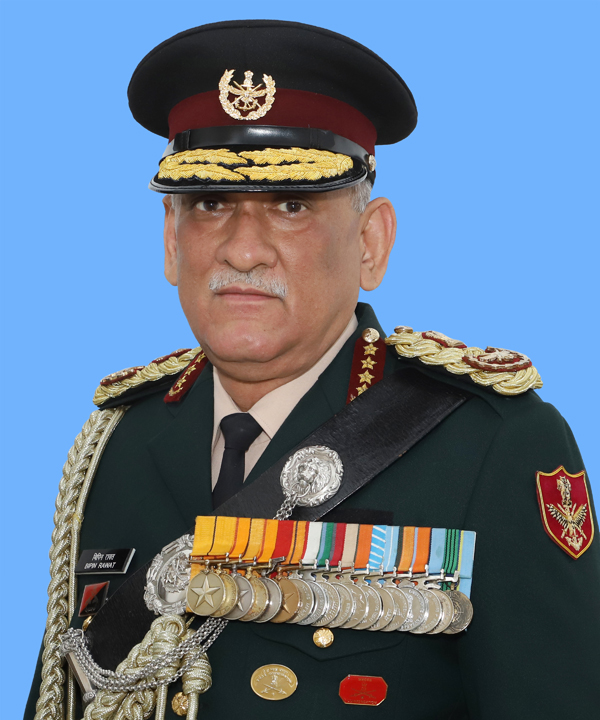
The breakthrough came in 2019, when the government announced the creation of the CDS and, in December of that year, appointed General Bipin Rawat as India's first Chief of Defence Staff. Alongside the post came a new Department of Military Affairs (DMA) inside the Ministry of Defence, headed by the CDS and given the explicit mandate to promote jointness and, crucially, to bring about the creation of theatre commands.[3] For the first time, someone in the Indian system was formally responsible for making the three services fight as one.
General Rawat pursued theaterisation with characteristic bluntness, and characteristic friction. His death in a helicopter crash in December 2021 slowed the process and left it without its most forceful champion. The appointment of General Anil Chauhan as the second CDS in 2022 revived momentum, but on a more consultative footing — an acknowledgement that a reform which the services resist cannot simply be imposed from above.
What the new structure is meant to look like
The broad design that has emerged envisions a small number of integrated theatre commands, each responsible for a slice of India's strategic geography and each drawing on all three services. Public discussion has centred on a structure of roughly three such commands: a Northern land-focused theatre oriented toward the China frontier, a Western theatre oriented toward Pakistan, and a Maritime theatre responsible for the Indian Ocean and the peninsular coasts.[1]
Under such a scheme, a theatre commander would not have to request cooperation from another service; the fighter squadrons, the missile regiments, the naval task groups and the ground formations within the theatre would already be his to command. The service headquarters in Delhi — Army, Navy and Air Force — would shift from operational control toward what militaries call "raise, train and sustain": recruiting, equipping and preparing forces, then handing them to the theatres to fight. It is a profound change of role, and it is precisely this change that has generated the fiercest debate.
Two enabling commands complete the architecture. India already stood up a tri-service Andaman and Nicobar Command in 2001 — its first and, for two decades, only integrated theatre command, a laboratory for jointness at the mouth of the Malacca Strait. It has also created a Defence Cyber Agency, a Defence Space Agency and a Special Operations Division, tri-service bodies that are widely seen as embryos of future full commands for the new domains of war.[3]
Why the Air Force pushed back
No account of theaterisation is honest without confronting the resistance, and the most substantive resistance has come from the Indian Air Force. Its objection is not mere turf-protection, though turf is never absent; it is a genuine argument about how air power works. The Air Force is a comparatively small force of fighter squadrons — India has long operated below its sanctioned strength — and its central doctrine holds that air power is most effective when concentrated and switched rapidly across the whole theatre of war, not parcelled out and tied down to individual land or sea commanders.[4]
Divide a scarce fleet of fighters among three theatres, the airmen warn, and you may end up with three commands each too weak to win its own air battle, unable to mass at the decisive point. The Air Force's preferred model has favoured functional air commands that can surge assets wherever they are needed, rather than permanently allocating squadrons to geographic theatres. This is a serious professional disagreement, not obstruction, and any workable Indian model has had to find ways to reassure the airmen that jointness will not blunt the very edge that makes air power valuable.
The Army and Navy, broadly, have been more comfortable with theaterisation — the Army because it fights on the ground where integration with air and fires is obviously decisive, the Navy because it already thinks in terms of self-contained task forces combining sea, air and sub-surface power. But even they have argued over the details: how many theatres, where the boundaries fall, who commands them, and how the rotation of the top job among the three services will work.
Jointness is not the surrender of a service's identity. It is the discovery that the identity was never the point.
The quiet reforms that had to come first
Theatre commands cannot simply be announced; they have to be plumbed. Three services that grew up separately use different radios, different data links, different logistics chains and, in some cases, different words for the same thing. Before the theatres could work, India had to lay the connective tissue of jointness — and much of this less glamorous work has been proceeding steadily beneath the headlines.
The government moved to establish joint logistics nodes at key locations, so that fuel, ammunition and spares could be shared across services instead of duplicated. It pushed common training and cross-postings, sending officers of one service to serve and study alongside the others, on the theory that officers who have worked together in peace will trust each other in war. It worked on inter-operable communications and networks so that a soldier, a pilot and a sailor can share a common operating picture. And it advanced legislation and rules to give commanders of one service the legal authority to exercise disciplinary and operational control over personnel of another — a mundane but essential prerequisite, since a commander cannot command troops he has no lawful power over.[3]
The China factor
The strategic urgency behind theaterisation is, ultimately, China. The standoff along the Line of Actual Control that began in 2020, and the deadly clash in the Galwan Valley that came with it, was a violent reminder that India's most demanding military problem is a two-front possibility: a China frontier of extraordinary length and altitude, and a Pakistan front that could flare in concert.[5]
Against an adversary that has already integrated its own forces into theatre commands built for exactly this contingency, India cannot afford to fight in three separate conversations. The whole point of a Northern theatre is that a single commander, watching a single map, can move a mountain brigade, vector a fighter sweep, task a reconnaissance drone and cue a missile strike as one coordinated act, at the speed the terrain and the threat demand. The gap between that ideal and the older, siloed reality is the gap theaterisation exists to close.
The risks of getting it wrong
Reform on this scale carries real danger, and its critics are not wrong to point it out. A botched reorganisation — new commands stood up without the communications, the logistics, the trained joint staff and the legal authorities to make them function — could leave India worse off than before, with the old structures dismantled and the new ones not yet working. Militaries have been hollowed out by reforms done for their own sake.
There is also the human dimension. Theaterisation reshuffles careers, dilutes the primacy of the individual service chiefs, and asks proud institutions to subordinate parts of their identity to a joint whole. Handled clumsily, it can breed resentment that quietly sabotages integration from within; handled well, it can build a generation of officers who think purple — the colour, in military shorthand, of jointness — from the start of their careers. The difference lies less in the org chart than in the culture, and culture is the slowest thing of all to change.
Finally, there is the question of civil-military design. Theatre commanders will wield enormous concentrated power. A mature system surrounds that power with clear political direction, robust institutional checks and a Ministry of Defence capable of giving strategic guidance rather than merely processing files. Part of the reform, therefore, is not just about the uniforms; it is about building the civilian strategic apparatus that can direct a joint military intelligently.
The American precedent: Goldwater-Nichols
Because India is walking a road others have travelled, the foreign precedents are worth understanding in some depth, and none is more instructive than the American one. Before 1986, the United States military — for all its size and wealth — fought as a collection of rival services whose inability to cooperate had produced a string of humiliations. The failed 1980 mission to rescue American hostages in Iran, in which aircraft and helicopters from different services could barely coordinate, ended in a fiery disaster in the desert. The 1983 invasion of Grenada, though successful, exposed almost comic failures of inter-service communication, with soldiers reportedly unable to talk to supporting ships. These were not failures of courage or equipment; they were failures of jointness.[1]
The Goldwater-Nichols Act of 1986 was the response, and it was revolutionary. It stripped the individual service chiefs of operational command over their forces, leaving them responsible for organising, training and equipping — the "raise, train and sustain" function — while operational command flowed through joint combatant commanders who answered directly to the civilian leadership. It made joint service a prerequisite for promotion to the highest ranks, forcing officers to spend part of their careers working alongside the other services if they wished to rise. Over the following decades, it transformed the American military from a set of feuding tribes into the most integrated fighting force in history. The point India draws from it is that jointness cannot be left to goodwill; it has to be built into the structure of command and the incentives of careers, or it will not take.
But the American precedent also carries a warning that India's Air Force is quick to cite. Goldwater-Nichols was imposed over the fierce objections of much of the uniformed leadership, and it took years — arguably a generation — for the culture to catch up with the law. The reform worked in the end because the United States had the time, the resources and the strategic breathing space to absorb the disruption. India, facing an already-integrated adversary across a live frontier, has less margin for a decade of painful transition, which is precisely why it has chosen a more consultative path even at the cost of speed.
The Chinese reform across the Himalayas
If the American precedent is instructive, the Chinese one is urgent, because it is India's actual adversary and it has already done what India debates. For most of its history the People's Liberation Army was organised into seven sprawling military regions, ground-force-dominated fiefdoms in which the army held sway and the navy, air force and missile forces were subordinate afterthoughts. Beginning in 2015, China's leadership undertook one of the most sweeping military reorganisations any nation has attempted in peacetime, tearing up the military-region system and replacing it with five integrated theatre commands, each combining ground, naval, air, rocket and support forces under a single joint commander oriented toward a specific strategic direction.[2]
One of those five, the Western Theatre Command, is oriented substantially toward India, responsible for the entire length of the disputed Himalayan frontier. It is designed, from the ground up, to fight a joint campaign on that border — to coordinate mountain troops, air power, missiles and support as a single integrated instrument. When Indian planners contemplate a future clash along the Line of Actual Control, they must reckon with the fact that on the other side stands not three separate services coordinating by telephone but a single command built expressly for combined-arms war in that theatre. The asymmetry is stark, and it is the sharpest single argument for why India cannot afford to keep fighting in three separate conversations.
The Chinese reform was possible because it was imposed by an authoritarian system with the power to override institutional resistance and reshuffle careers by fiat — a luxury, if it is one, that a democracy does not possess. India must achieve a comparable integration through persuasion, consensus and legislation, under public scrutiny and civilian control. That it is harder to do this way does not make it less necessary; it only makes it slower, and the pace of the Chinese reform is a constant, uncomfortable reminder of the clock India is racing against.
Andaman and Nicobar: the laboratory
India is not entirely without experience of jointness, and its one long-running experiment deserves attention because it is both an encouragement and a cautionary tale. The Andaman and Nicobar Command, established in 2001, was India's first — and for over two decades its only — integrated tri-service theatre command, placing army, navy and air force units in the strategically vital island chain at the mouth of the Malacca Strait under a single commander who rotates among the three services.[3]
As a laboratory for jointness, it has taught valuable lessons. It has shown that officers of different services can work under a common command, that a joint staff can function, and that the rotation of the top job among the services can work in practice. But it has also revealed the obstacles: critics have long argued that the command was never given the resources, the forces or the authority to realise its full potential, and that it remained something of an under-powered experiment rather than a fully empowered theatre. The lesson India draws is double-edged — that jointness is achievable, but that a theatre command starved of resources and real authority becomes a hollow structure, integrated on paper but weak in practice. The future theatres must be given the substance the Andaman command sometimes lacked.
How many theatres, and where the lines fall
Beneath the grand principle of theaterisation lies a thicket of intensely practical disputes, and chief among them is the sheer question of geometry: how many theatres, and where their boundaries should fall. The public discussion has centred on a structure of roughly three integrated commands — a northern land theatre facing China, a western theatre facing Pakistan, and a maritime theatre for the seas — but every element of that design has been contested, because the boundaries determine who commands what, which service leads where, and how forces are allocated.[1]
The debates are not trivial. Should the China and Pakistan fronts be separate theatres, or does the possibility of a two-front war argue for coordinating them under a common design? How should the boundary between a land theatre and the maritime theatre be drawn along the coasts? How are scarce, high-value assets — the limited fighter squadrons, the strategic forces, the specialised enablers — to be divided or shared among theatres without leaving each too weak? Every answer creates winners and losers among the services and among commands, and every boundary drawn on the map is a decision about power, resources and primacy. This is why the reform has moved so deliberately: the geometry is not a detail but the substance of the thing, and getting it wrong would build in weaknesses that a war would ruthlessly expose.
The changing role of the service chiefs
Perhaps the most profound and personally sensitive change theaterisation brings is the transformation in the role of the three service chiefs — the men who currently sit atop the Army, Navy and Air Force. Under the old system, a service chief commands his service in every sense: he raises it, trains it, equips it, and directs it in operations. Under a theaterised system, that operational authority passes to the theatre commanders, and the service chief's role narrows to the vital but less glamorous function of building and sustaining the force he then hands over to the theatres to fight.[1]
This is a genuine diminution of the individual chiefs' operational power, and it would be naive to imagine it is welcomed without reservation by institutions and individuals accustomed to command. It reshuffles the hierarchy of the entire military, creates new and powerful positions in the theatre commanders, and raises delicate questions about seniority, rotation and the relationship between the chiefs, the theatre commanders and the Chief of Defence Staff. Managing this human and institutional transition — persuading proud services to accept a redefinition of their leaders' roles — is as much a part of the reform as any org chart, and it is a large part of why the process demands patience and consensus rather than diktat.
The plumbing beneath the reform
It bears repeating and expanding upon that theatre commands cannot function without an enormous amount of unglamorous underlying work, because it is in this plumbing that reforms most often quietly fail. Three services that grew up separately have, over decades, developed incompatible systems at every level — different radios and data links that cannot talk to each other, different logistics and supply chains that duplicate rather than share, different procedures, different training, even different terminology for the same battlefield realities. A theatre commander handed forces from all three services but no common means of connecting them commands a Babel, not an army.[3]
The connective tissue India has been laying beneath the headlines — joint logistics nodes that let the services share fuel, ammunition and spares; common and inter-operable communications so that a soldier, sailor and pilot can share a single operating picture; cross-postings and joint training that build the personal trust integration requires; and the legal frameworks that give a commander of one service lawful authority over the personnel of another — is therefore not preliminary to the reform but constitutive of it. Without this plumbing, the theatres would be empty vessels. With it, they become real. And because this work is slow, technical and invisible, it rarely gets the attention it deserves, even though it may matter more to the ultimate success of theaterisation than any announcement of a new command.
The two-front problem
Looming over the entire debate about theaterisation is the strategic nightmare that most shapes Indian planning: the possibility of a two-front war, with China across the northern frontier and Pakistan to the west, potentially acting in concert. This is the contingency that Indian strategists must plan against, and it is one of the strongest arguments for integration, because a nation facing threats on two fronts simultaneously cannot afford the inefficiency of fighting each in three separate service conversations.[5]
The two-front problem shapes the very geometry of theaterisation. It raises the question of whether the China and Pakistan fronts should be separate theatres or coordinated under a common design; of how forces should be allocated between them; and of how India could shift strength from one front to another if a crisis on one escalated while the other remained quiet. An integrated command structure, in principle, allows exactly this kind of flexible, coordinated response — the ability to see the whole strategic picture and move forces and effects where they are most needed, rather than managing two separate wars through two separate sets of service silos. The standoff along the Line of Actual Control that began in 2020, and the persistent tension on the western border, are constant reminders that this is not a theoretical exercise but the central strategic problem the reform must solve.
The two-front scenario also underlines why the pace of Chinese integration across the Himalayas matters so much to Indian planners. An adversary that has already built theatre commands designed for combined-arms war on its periphery holds an advantage in tempo and coordination that India cannot afford to concede, least of all in a contingency where it might face pressure on two fronts at once. The theaterisation reform is, in a real sense, India's answer to a strategic environment that has grown more dangerous and more integrated — an attempt to ensure that if the worst came, India could fight as one country rather than as three services managing two separate wars.
The nuclear and strategic dimension
A dimension of theaterisation that receives less public attention, but that carries enormous weight, is its relationship to India's strategic and nuclear forces. India's nuclear deterrent is managed through a separate command structure, deliberately kept under tight political control, and the question of how this strategic dimension relates to the conventional theatre commands is a sensitive and important one. The reform must ensure that the integration of conventional forces strengthens rather than complicates the clear political control and careful management that nuclear weapons demand.[6]
More broadly, theaterisation intersects with the whole architecture of India's higher defence management — the relationship between the military, the Ministry of Defence, and the political leadership. Theatre commanders will wield concentrated power over large integrated forces, and a mature system must surround that power with clear political direction, robust institutional checks, and a civilian defence apparatus capable of providing genuine strategic guidance rather than merely processing paperwork. Part of the reform, therefore, is not only about reorganising the uniforms but about strengthening the civilian strategic machinery that must direct a more integrated and powerful military — building the institutions of political control and strategic direction that a joint force requires. This civil-military dimension is among the most important and least discussed aspects of the entire undertaking, and getting it right is essential to ensuring that a more integrated military remains firmly under democratic control.
Where it stands, and why it will define a generation
India has chosen the harder, slower path: reform by persuasion rather than diktat, feeling for a model that the Air Force can live with, that the Army and Navy can use, and that a democracy can control. That deliberateness has frustrated those who want theatre commands declared tomorrow. But a reform imposed over the professional objections of the people who must operate it is a reform that fails on first contact with a real war.
What is no longer in doubt is the direction. The creation of the CDS and the Department of Military Affairs made jointness someone's explicit job. The tri-service agencies for cyber, space and special operations are the seeds of future commands. The plumbing — logistics, communications, joint training, legal authority — is being laid. The strategic environment, with an integrated PLA across the Himalayas, admits of no long-term alternative.
Theaterisation will not be finished in a single announcement or a single year. It is a generational project, and like all such projects it will be judged not by the elegance of its plans but by whether, on some future day of crisis, an Indian commander can look at a single map and move land, sea, air, space and cyber power as one. That is the whole ambition of the most important military reform in India's history — to make three services, at last, into one country's sword.
Sources & further reading
- "Integrated Theatre Command (India)," Wikipedia.
- "Theater command (People's Liberation Army)," Wikipedia.
- "Chief of Defence Staff (India)," Wikipedia.
- Manohar Parrikar Institute for Defence Studies and Analyses (MP-IDSA) — idsa.in.
- "2020–2021 China–India skirmishes," Wikipedia.
- Ministry of Defence, Government of India — mod.gov.in.