History · 1971
The Battle of Longewala: 120 Against a Brigade
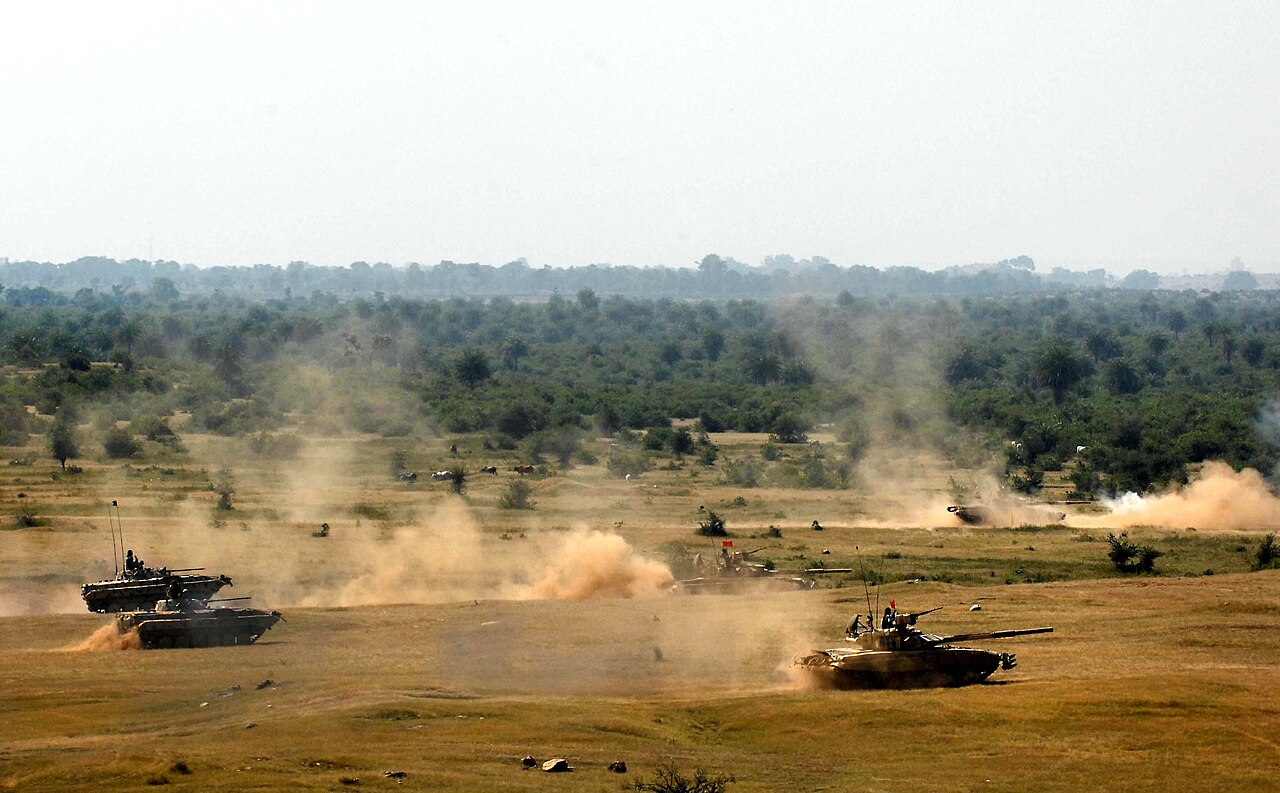
Some battles are won by numbers, and some by sheer, stubborn refusal to break. The Battle of Longewala, fought on the night of 4–5 December 1971, belongs firmly to the second kind — a handful of men in the desert holding a line that, by every rational calculation, should have been overrun.
It is the very embodiment of the spirit my book keeps returning to: the choice to stand, against the odds, for the soil behind you.
A post in the desert
As the 1971 war opened, Pakistan launched a major thrust into Indian territory in the Thar desert of Rajasthan, aiming to capture the town of Jaisalmer. In its path lay a small, isolated border post at Longewala, held by 'A' Company of the 23 Punjab — around 120 men under Major Kuldip Singh Chandpuri.[1]
On the night of 4 December, Chandpuri's tiny garrison detected an enormous enemy force advancing on them: an infantry brigade backed by a regiment of tanks — many dozens of armoured vehicles against a single company with no tanks of their own.[1]
"Let them come," we say, "we shall not fall, for the land we guard is worth it all."
The decision to hold
Chandpuri faced a brutal choice: withdraw and surrender the post, or hold and almost certainly be wiped out. He chose to hold, and asked his men to fight through the night, buying time until air support could arrive at first light.[1]
Through the dark hours, the company fought a desperate defensive battle. They used the terrain cleverly, channelled the enemy armour, and made every weapon count — anti-tank guns, medium machine guns, and sheer nerve. A minefield and soft sand slowed the tanks; the defenders' discipline did the rest. Against overwhelming odds, the thin line at Longewala did not break.
Dawn, and the Hunters
When morning came, the Indian Air Force arrived. Hunter fighter-bombers swept over the desert and fell upon the exposed Pakistani armour, which had no air cover of its own. In the open desert, the tanks were terribly vulnerable. Through the day, the air strikes turned the stalled offensive into a rout, destroying a large number of vehicles.[1]
What had begun as a hopeless last stand by 120 men ended as one of the most lopsided defensive victories of the war. Major Chandpuri was awarded the Maha Vir Chakra, India's second-highest wartime gallantry award, for his leadership.[1]
The legend, and the truth
Longewala became famous far beyond military circles, immortalised in the Hindi film Border. As with any legend, the cinematic version simplifies and dramatises. But the core of the story is true and remarkable: a small, outnumbered force chose to hold a desert post against an armoured brigade, fought through the night, and survived to see the enemy broken by dawn.
What makes Longewala endure is not just the spectacular outcome but the decision at its heart — Chandpuri's choice to hold when retreat would have been entirely reasonable. The victory was sealed by air power, but it was made possible by the men on the ground who refused to leave.
The arithmetic of courage
Longewala is often told as a tale of clever tactics and timely air support, and it is both. But underneath, it is a story about a kind of arithmetic that has nothing to do with numbers: the willingness of a few to stand firm so that the many behind them stay safe.
120 men against a brigade is not a fair fight. The defenders of Longewala fought it anyway, and held, because the alternative — opening the road to Jaisalmer — was unthinkable to them. "The land we guard is worth it all," says the soldier in my poem. At Longewala, a company of ordinary men proved exactly how much they meant it.
Sources & further reading
All images via Wikimedia Commons, used under the licences shown in each caption.