History · 1971
1971: The War That Gave Birth to a Nation
Some wars are fought to take land. The war of 1971 was fought to give a people their freedom. In thirteen days in December, the Indian Army helped bring a new country — Bangladesh — into the world, and accepted a surrender so large it remains, to this day, the biggest since the Second World War.
My poem Liberation's Shadow is written in the voice of an Indian soldier of that war: "We marched not for conquest, not for pride, but for a neighbor's freedom, their voices tied." This is the history those lines remember.
A genocide across the border
Through 1971, the Pakistani military waged a brutal crackdown in what was then East Pakistan, driving an estimated ten million refugees across the border into India. The humanitarian catastrophe and the strategic crisis it created pushed India toward intervention.[1]
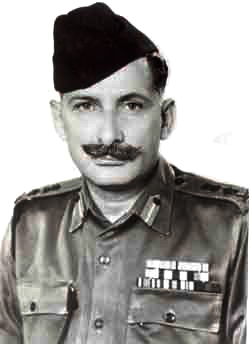
When the army chief, General (later Field Marshal) Sam Manekshaw, was asked to act in spring, he famously insisted on waiting until the monsoon passed and the army was fully prepared — a refusal to be rushed that helped guarantee the swift victory that followed.[2]
In the heart of Bangladesh, we left a piece, of ourselves, in its soil, a promise of peace.
Thirteen days
Full-scale war began on 3 December 1971. On land, sea, and in the air, Indian forces and the Mukti Bahini (Bangladeshi freedom fighters) advanced rapidly toward Dhaka. The Indian Navy struck Karachi; the Air Force won command of the skies; the Army drove forward faster than almost anyone expected.[1]
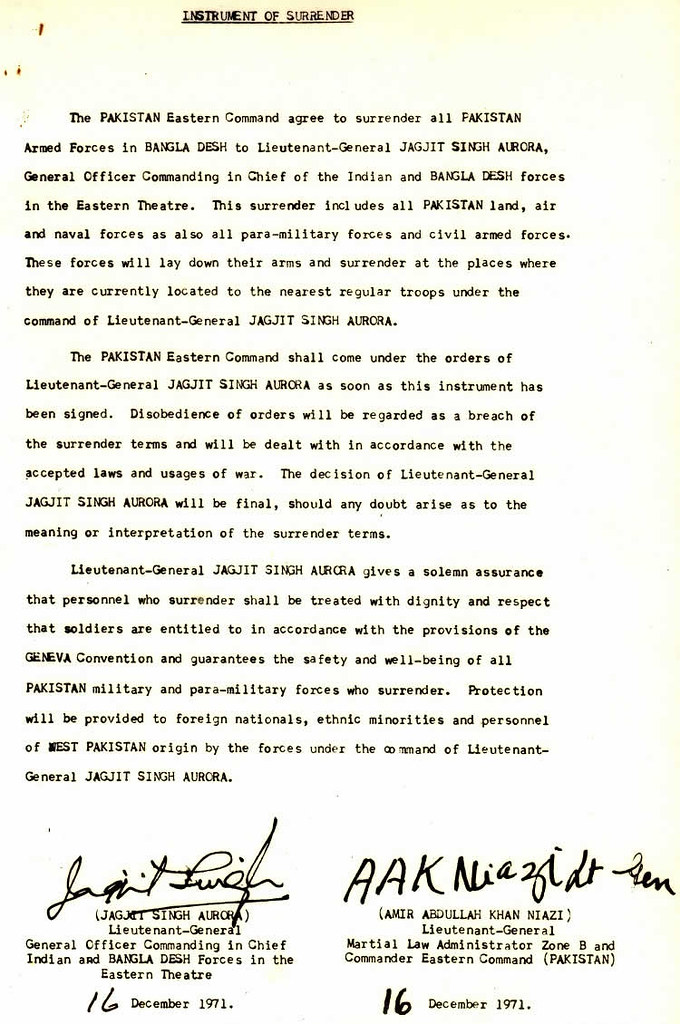
On 16 December 1971, Lieutenant General A. A. K. Niazi signed the Instrument of Surrender in Dhaka, and around 93,000 Pakistani soldiers laid down their arms — the largest surrender of troops since 1945. Bangladesh was free. India marks the day every year as Vijay Diwas (Victory Day).[1]
Victory without vanity
What makes 1971 extraordinary is not only its speed but its restraint. India took no territory for itself; it returned its prisoners of war; it had fought, as the poem says, "not for conquest but for the freedom of a neighbor." It was a war that expanded the map of human freedom rather than the map of a nation.
Yet victory was paid for in blood. Thousands of Indian soldiers fell so that a new flag could rise over Dhaka. They asked, as soldiers always seem to, only to be remembered "not for the medals we bear, but for the battles fought with love and care." Fifty years on, that is exactly what Vijay Diwas is for.
Sources & further reading
All images via Wikimedia Commons, used under the licences shown in each caption.